ploeh blog danish software design
Song recommendations with pipes and filters
Composing small Recawr Sandwiches.
This article is part of a larger series that outlines various alternative ways to design with functional programming. That (first) article contains a table of contents, as well as outlines the overall programme and the running example. In short, the example is a song recommendation engine that works on large data sets.
Previous articles in this series have explored refactoring to a pure function and composing impure actions with combinators. In the next few articles, we'll look at how to use message-based architectures to decouple the algorithm into smaller Recawr Sandwiches. As an overall concept, we may term such an architecture pipes and filters. The book Enterprise Integration Patterns is a great resource for this kind of (de)composition. Don't be mislead by the title: In essence, it's neither about enterprise programming nor integration.
Workflows of small sandwiches #
As speculated in Song recommendations as an Impureim Sandwich, the data sets involved when finding song recommendations for a user may be so large that an Impureim Sandwich is impractical.
On the other hand, a message-based system essentially consists of many small message handlers that each may be implemented as Impureim Sandwiches. I've already briefly discussed this kind of decomposition in Pure interactions, where each message handler or 'actor' is a small process equivalent to a web request handler (Controller) or similar.
When it comes to the song recommendation problem, we may consider a small pipes-and-filters architecture that uses small 'filters' to start even more work, handled by other filters, and so on.

Depending on the exact implementation details, you may call this pipes and filters, reactive functional programming, the actor model, map/reduce, or something else. What I consider crucial in this context is that each 'filter' is a small Recawr Sandwich. It queries the out-of-process music data service, applies a pure function to that data, and finally sends more messages over some impure channel. In the following articles, you'll see code examples.
- Song recommendations with C# Reactive Extensions
- Song recommendations with F# agents
As I'm writing this, I don't plan to supply a Haskell example. The main reason is that I've no experience with writing asynchronous message-based systems with Haskell, and while a quick web search indicates that there are plenty of libraries for reactive functional programming, on the other hand, I can't find much when it comes to message-bus-based asynchronous messaging.
Perhaps it'd be more idiomatic to supply an Erlang example, but it's been too many years since I tried teaching myself Erlang, and I never became proficient with it.
Modelling #
It turns out that when you decompose the song recommendation problem into smaller 'filters', each of which is a Recawr Sandwich, you arrive at a decomposition that looks suspiciously close to what we saw in Song recommendations from combinators. And as Oleksii Holub wrote,
"However, instead of having one cohesive element to reason about, we ended up with multiple fragments, each having no meaning or value of their own. While unit testing of individual parts may have become easier, the benefit is very questionable, as it provides no confidence in the correctness of the algorithm as a whole."
This remains true here. Why even bother, then?
The purpose of this article series is to present alternatives, just like Scott Wlaschin's excellent article Thirteen ways of looking at a turtle. It may be that a given design alternative isn't the absolute best fit for the song recommendation problem, but it may, on the other hand, be a good fit for some other problem that you run into. If so, you should be able to extrapolate from the articles in this series.
Conclusion #
Given that we know that the real code that the song recommendation example is based off runs for about ten minutes, some kind of asynchronous process that may support progress indication or cancellation may be worth considering. This easily leads us in the direction of some kind of pipes-and-filters architecture.
You can implement such an architecture with in-memory message streams, as the next article does, or you can go with a full-fledged messaging system based on persistent message buses and distributed, restartable message handlers. The details vary, but it's essentially the same kind of architecture.
Next: Song recommendations with C# Reactive Extensions.
A parser and interpreter for a very small language
A single Haskell script file.
I recently took the final exam in a course on programming language design. One of the questions was about a tiny language, and since this was a take-home exam running over many days, I had time to spare. Although it wasn't part of any questions, I decided to write an interpreter to back up some claims I made in my answers.
This article documents my prototype parser and interpreter.
Language description #
To be clear, the exam question was not to implement an interpreter, but rather some questions about attributes of the language. The description here is reprinted with kind permission from Torben Ægidius Mogensen.
Consider a functional language where values can be Booleans and pairs. A syntax for the language is given below:
Program → Function+ Function → Fid Pattern+ = Exp Pattern → Vid | true|false| (Pattern, Pattern)Exp → Vid | true|false| Fid Exp+ | (Exp)where Fid denotes function identifiers (which are lower case) and Vid denotes variable identifiers (which are upper case). There can be multiple rules for each functions, but rules must have disjoint patterns. All function calls must be fully applied (no partial applications, so no higher-order functions). A program is executed by calling any function with any argument constructed by pairs and Booleans. An example program is
and true X = X
and false X = false

alltrue true = true
alltrue false = false
alltrue (X, Y) = and (alltrue X) (alltrue Y)
Calling
alltrue (true, (false, true))will returnfalse, butalltrue ((true, true), (true, true))will returntrue.
The exam goes on to ask some questions about termination as a property of the language, and whether or not it's Turing complete, but that's not the scope of this article. Rather, I'd like to describe a prototype parser and interpreter I wrote as a single throwaway script file in Haskell.
Declarations and imports #
The code is a single Haskell module that I interacted with via GHCi (the GHC REPL). It starts with a single pragma, a module declaration, and imports.
{-# LANGUAGE FlexibleContexts #-}
module Bopa where

import Control.Monad.Identity (Identity)
import Data.Bifunctor (first)
import Data.Foldable (find)
import Data.List.NonEmpty (NonEmpty((:|)))
import qualified Data.List.NonEmpty as NE
import Data.Set (Set)
import qualified Data.Set as Set
import Text.Parsec
The parsec API requires the FlexibleContexts language pragma. The name, Bopa I simply derived from Bools and Pairs, although I'm aware that this little combination of letters has quite an alternative connotation for many Danes, including myself.
Apart from the base library, the packages parsec and containers are required. I didn't use an explicit build system, but if they're not already present on your system, you can ask GHCi to load them.
AST #
The above language description is a context-free grammar, which translates easily into Haskell type declarations.
type Program = NonEmpty Function
data Function =
  Function { fid :: String, fpats :: NonEmpty Pattern, fbody :: Exp }
  deriving (Eq, Show)
data Pattern =
  VarPat String | TPat | FPat | PairPat Pattern Pattern deriving (Eq, Show)
data Exp =
  VarExp String | TExp | FExp | CallExp String (NonEmpty Exp)
  deriving (Eq, Show)
The description doesn't explicitly state how to interpret the superscript +, but I've interpreted it as meaning one or more. Therefore, a Program is a NonEmpty list of Function values. The same line of reasoning applies for the other places where the + sign appears.
Notice that there's more than one representation of Boolean values; TPat is the true pattern, while TExp is the true expression, and likewise for false.
These types describe the entire language, and you can, in principle, create programs directly using this API. While I didn't do that (because I wrote a parser instead), here's what the above and function looks like as an abstract syntax tree (AST):
Function "and" (TPat :| [VarPat "X"]) (VarExp "X") :| [Function "and" (FPat :| [VarPat "X"]) FExp]
Recall that the :| operator is the NonEmpty data constructor.
Source code parsers #
I wanted to be able to write programs directly in the Bopa language, and not just as ASTs, so the next step was writing parsers for each of the data types defined above. As strongly implied by the above imports, I used the parsec package for that.
The Program type is only an alias, and once I have a parser for Function, that one should be straightforward. The parser of Function values is, however, more involved.
functionParser :: Stream s m Char => ParsecT s () m Function
functionParser = do
  fnid <- many1 lower
  let pp = many1 (char ' ') >> patternParser
  -- Next line based on https://stackoverflow.com/a/65570028/126014
  patterns <- (:|) <$> pp <*> pp `manyTill` try (many1 (char ' ') >> char '=')
  skipMany1 (char ' ')
  Function fnid patterns <$> expParser
I readily admit that I don't have much experience with parsec, so it's possible that this could be done more elegantly. As the comment indicates, I struggled somewhat with a detail or two. I had trouble making it consume patterns until it meets the '=' character.
The functionParser depends on another parser named pairPatParser, which again is composed from smaller parsers that handle each case of the Pattern sum type.
varPatParser :: Stream s m Char => ParsecT s () m Pattern
varPatParser = VarPat <$> many1 upper

tPatParser :: Stream s m Char => ParsecT s () m Pattern
tPatParser = string "true" >> return TPat

fPatParser :: Stream s m Char => ParsecT s () m Pattern
fPatParser = string "false" >> return FPat

pairPatParser :: Stream s m Char => ParsecT s () m Pattern
pairPatParser = do
  _ <- char '('
  p1 <- patternParser
  _ <- char ','
  _ <- skipMany $ char ' '
  p2 <- patternParser
  _ <- char ')'
  return $ PairPat p1 p2

patternParser :: Stream s m Char => ParsecT s () m Pattern
patternParser =
  try varPatParser <|> try tPatParser <|> try fPatParser <|> try pairPatParser
You might argue that the first three are so simple that they may not really qualify for the status of top-level values, but being a parsec newbie, I found that it helped me to structure the code that way. The only one of those values more complicated than a one-liner is, obviously, pairPatParser. I later discovered between and sepBy1, so it's possible I could also have defined pairPatParser as a composition of such combinators. I didn't, however, try, since this is, after all, throwaway prototype code, and what's there already works as intended.
As an aside, I would usually keenly attempt such refactorings, but I was working without automated tests. Yes, shocking, I know, but setting up unit tests for Haskell is, unfortunately, a bit of a hassle, and given the nature of the work, I considered doing without tests a reasonable trade-off.
This takes care of parsing Pattern values, but notice that functionParser also depends on expParser, which, not surprisingly, parses Exp values. Like patternParser it does that by defining a helper parser for each sum type case, and then combining them into one larger parser.
varExpParser :: Stream s m Char => ParsecT s () m Exp
varExpParser = VarExp <$> many1 upper

tExpParser :: Stream s m Char => ParsecT s () m Exp
tExpParser = string "true" >> return TExp

fExpParser :: Stream s m Char => ParsecT s () m Exp
fExpParser = string "false" >> return FExp

callExpParser :: Stream s m Char => ParsecT s () m Exp
callExpParser = do
  fnid <- many1 lower
  skipMany1 (char ' ')
  exps <- NE.fromList <$> expParser `sepBy1` many1 (char ' ')
  return $ CallExp fnid exps

expParser :: Stream s m Char => ParsecT s () m Exp
expParser =
  try varExpParser <|>
  try tExpParser <|>
  try fExpParser <|>
  try callExpParser <|>
  between (char '(') (char ')') expParser
Even though I generally favoured implementing each sum type case in a separate, named parser, I inlined parsing of the parenthesized expression; partly because it's so simple, and partly because I didn't know what to call it.
You can see that at this point, I'd discovered the between and sepBy1 combinators.
Finally, it's possible to compose all these smaller parsers together to a parser of Bopa programs.
programParser :: Stream s m Char => ParsecT s () m (NonEmpty Function)
programParser = NE.fromList <$> functionParser `sepEndBy1` many1 endOfLine
This, however, is parser. How do you run it?
Here's a way:
parseProgram :: Stream s Identity Char
             => s -> Either ParseError (NonEmpty Function)
parseProgram = parse programParser ""
You may, for example, try to parse the above and function:
ghci> parseProgram "and true X = X\nand false X = false"
Right (Function {fid = "and", fpats = TPat :| [VarPat "X"], fbody = VarExp "X"} :|
      [Function {fid = "and", fpats = FPat :| [VarPat "X"], fbody = FExp}])
(Output manually formatted to improve readability.)
In practice, however, I didn't much do that. Instead, I created source code files and loaded them with the basic file-reading APIs included in the base package. You'll see examples of this later.
Arguments #
As described, running a program requires construction of a Boolean value, or pairs of Boolean values, something the language itself does not allow. That's the reason I haven't yet modelled it.
data Arg = TArg | FArg | PairArg Arg Arg deriving (Eq, Ord, Show)
Notice that true and false gets yet another representation as either TArg or FArg.
If I want to be able to run programs by typing alltrue (true, (false, true)), instead of painstakingly creating ASTs, I need a parser for this data type as well. That's not going to be a source code parser, but rather part of a command-line parser.
tArgParser :: Stream s m Char => ParsecT s () m Arg
tArgParser = string "true" >> return TArg

fArgParser :: Stream s m Char => ParsecT s () m Arg
fArgParser = string "false" >> return FArg

pairArgParser :: Stream s m Char => ParsecT s () m Arg
pairArgParser = do
  _ <- char '('
  p1 <- argParser
  _ <- char ','
  _ <- skipMany $ char ' '
  p2 <- argParser
  _ <- char ')'
  return $ PairArg p1 p2

argParser :: Stream s m Char => ParsecT s () m Arg
argParser = tArgParser <|> fArgParser <|> pairArgParser
To be honest, I think that I just copied and pasted pairPatParser and changed a few things. It looks that way, doesn't it?
Entry points #
In order to execute a program, you need more than arguments. You need to define which function to call. I decided that this was close enough to defining a program entry point that it gave name to the next type.
data Entry = Entry String (NonEmpty Arg) deriving (Eq, Show)
The String value identifies the desired function by name, and the NonEmpty list supplies the arguments.
Since I wish to be able to run a program by writing e.g. alltrue ((true, true), (true, true)), I need a parser for that, too.
entryParser :: Stream s m Char => ParsecT s () m Entry
entryParser = do
  fnid <- many1 lower
  skipMany1 (char ' ')
  args <- NE.fromList <$> argParser `sepBy1` many1 (char ' ')
  return $ Entry fnid args
This, again, is a parser; it's convenient to also define a function to run it against input.
parseEntry :: Stream s Identity Char => s -> Either ParseError Entry
parseEntry = parse entryParser ""
Let's see if it works:
ghci> parseEntry "alltrue ((true, true), (true, true))"
Right (Entry "alltrue" (PairArg (PairArg TArg TArg) (PairArg TArg TArg) :| []))
That seems promising.
Parameter binding #
Armed with the ability to parse programs as well as entry points, 'all' that remains is to execute the program. To that end, I wrote an interpreter. It works with a few helper functions, the first of which attempts to bind patterns to arguments.
For example, if we have a variable-name pattern such as X and an argument such as (true, false), we can bind X to that value. Some examples will help, but I'll show the function first, and then talk you through it.
-- Attempt pattern matching and, if possible, bind variables to arguments.
-- Returns an association list of bound variables (an 'environment'), if any.
-- Returns Left with an error message if no match.
tryBind :: NonEmpty Pattern -> NonEmpty Arg -> Either String [(String, Arg)]
tryBind (VarPat p :| []) (arg :| []) = Right [(p, arg)]
tryBind (TPat :| []) (TArg :| []) = Right []
tryBind (FPat :| []) (FArg :| []) = Right []
tryBind (PairPat p1 p2 :| []) ((PairArg a1 a2) :| []) =
  let b1 = tryBind (NE.singleton p1) (NE.singleton a1)
      b2 = tryBind (NE.singleton p2) (NE.singleton a2)
  in (++) <$> b1 <*> b2
tryBind (pat :| (p:ps)) (arg :| (a:as)) =
  let b  = tryBind (NE.singleton pat) (NE.singleton arg)
      bs = tryBind (p :| ps) (a :| as)
  in (++) <$> b <*> bs
tryBind _ args = Left ("Could not match " ++ show args ++ ".")
Notice the type declaration: The function takes a NonEmpty list of Pattern values, and another NonEmpty list of Arg values. The first precondition in order to achieve a successful result is that these two lists need to have the same length. If we have more arguments than patterns, we run out of patterns. If we have more patterns than arguments, we can't bind all the parameters in the patterns, and partial application is not allowed.
The first four rules of the tryBind function attempt to match a single Pattern value to a single Arg value; notice the use of the :| NonEmpty data constructor: In all four cases, the tail of the NonEmpty lists only matches the empty list [].
The first rule, for example, has a single variable pattern, where p is the variable name, and a single argument arg, so that pattern matching succeeds and the variable name is bound to the argument. Here's an example:
ghci> tryBind (VarPat "X" :| []) (PairArg TArg FArg :| [])
Right [("X",PairArg TArg FArg)]
The result is a variable environment in which the variable name X is bound to the value PairArg TArg FArg (that is, (true, false)).
Sometimes, when matching literals, no variables are bound, in which case the environment is empty:
ghci> tryBind (TPat :| []) (TArg :| [])
Right []
While the environment itself is empty, the result is still a Right case, indicating that the pattern matched the argument. This, of course, need not be the case:
ghci> tryBind (TPat :| []) (FArg :| [])
Left "Could not match FArg :| []."
The rule that attempts to match a pair with a pair argument recursively calls tryBind for the left and the right element, and then uses the Applicative nature of Either to compose those two results.
ghci> tryBind (PairPat TPat (VarPat "Y") :| []) (PairArg TArg FArg :| [])
Right [("Y",FArg)]
In this example, you see how a pair pattern composed of (true, Y) matches the argument (true, false), resulting in the variable environment where Y is bound to false.
The final Right-valued match is when there's more than a single pattern, and more than a single argument. In that case, the function recursively calls itself with the heads of each NonEmpty list, as well as the tails of each NonEmpty list.
ghci> tryBind (PairPat TPat (VarPat "Y") :| [VarPat "Z"]) (PairArg TArg FArg :| [PairArg FArg TArg])
Right [("Y",FArg),("Z",PairArg FArg TArg)]
In this example, we try to bind the variables in the patterns (true, Y) Z with the arguments (true, false) (false, true), producing the variable environment where Y is bound to false, and Z is bound to (false, true).
This exhausts all the legal bindings, so the final, wildcard pattern in tryBind returns a Left value indicating the failure. You've already seen an example of that, above.
That function is a bit of a mouthful, but fortunately, we've now covered a major part of the interpreter.
Pattern matching #
The tryBind function attempts to bind a single list of patterns to a list of arguments. A function may, however, list several (non-overlapping) rules, so if the first pattern list doesn't match, the interpreter must try the second, the third, and so on, until there are no more patterns to try. While tryBind does the heavy lifting, another function goes through the list of rules.
-- Goes through one or more function rules, looking for a match.
-- All the functions in the function list are assumed to have the same name, so
-- that they are all rules of the same function.
-- This precondition is not checked here, but handled by the caller. This isn't
-- the best implementation decision, but this is, after all, a prototype.
tryMatch :: NonEmpty Function
         -> NonEmpty Arg
         -> Either [Char] ([(String, Arg)], Exp)
tryMatch (Function _ pats body :| []) args = (, body) <$> tryBind pats args
tryMatch (Function _ pats body :| (f : fs)) args =
  case tryBind pats args of
    Right b -> Right (b, body)
    Left _ -> tryMatch (f :| fs) args
There are two (Haskell) rules for tryMatch: One where there's only one Function rule, and one where there's more than one.
In the first case, tryMatch delegates to tryBind, but if the binding attempt succeeds, also returns the body.
ghci> tryMatch (Function "and" (FPat :| [VarPat "X"]) FExp :| []) (FArg :| [TArg])
Right ([("X",TArg)],FExp)
This example attempts to bind the second rule of the above and function. Compare the input to the AST for and shown above. The result is a tuple where the first, or left, element is the variable environment, and the second, or right, element is the expression that matched.
It's important to return the matching expression, since tryMatch doesn't in itself evaluate the body. In case of multiple rules, the interpreter needs to know which body is associated with the matching pattern.
ghci> tryMatch (Function "and" (TPat :| [VarPat "X"]) (VarExp "X") :|
               [Function "and" (FPat :| [VarPat "X"]) FExp])
               (TArg :| [TArg])
Right ([("X",TArg)],VarExp "X")
ghci> tryMatch (Function "and" (TPat :| [VarPat "X"]) (VarExp "X") :|
               [Function "and" (FPat :| [VarPat "X"]) FExp])
               (FArg :| [TArg])
Right ([("X",TArg)],FExp)
(Inputs manually formatted for improved readability.)
These two examples try to pattern match the above and function. In the first example, the input is true false, which matches the first rule and true X = X. Therefore, the return value is Right ([("X",TArg)],VarExp "X"), indicating a new variable environment in which X is bound to true, and the matching body is VarExp "X", indicating that the variable X is returned.
In the second example, the input is (false, true), which now matches the second rule and false X = false. The returned tuple now indicates that X is still bound to true, but the returned body is now FExp, indicating the constant return value false.
In both cases, tryMatch starts in the second (Haskell) rule, since there are two parameters. In the first example, the first call to tryBind immediately returns a Right result, which is then returned. In the second example, on the other hand, the first call to tryBind returns a Left-value result, which causes tryMatch to recurse back on itself with the remaining (Bopa) rules.
Evaluation #
Given a variable environment and an expression, it's now possible to evaluate the expression to a value.
-- Evaluate an expression, given a program (AST) and an environment.
-- Also required as input is a set used for cycle detection. Set elements are
-- tuples, each consisting of a function identifier (name) and arguments to that
-- function. If the evaluator recursively sees that tuple again, it has detected
-- a cycle, and stops further evaluation.
eval :: Foldable t
     => Set (String, NonEmpty Arg)
     -> t (NonEmpty Function)
     -> [(String, Arg)]
     -> Exp
     -> Either String Arg
eval _ _ env (VarExp name) =
  maybe (Left ("Could not find variable " ++ name ++ ".")) Right $
  lookup name env
eval _ _ _ TExp = Right TArg
eval _ _ _ FExp = Right FArg
eval observedCalls prog env (CallExp fnid exps) = do
  rules <-
    maybe (Left ("Could not find function " ++ fnid ++ ".")) Right $
    find ((fnid ==) . fid . NE.head) prog
  args <- traverse (eval observedCalls prog env) exps
  (env', body) <- tryMatch rules args
  if Set.member (fnid, args) observedCalls
  then Left "Cycle detected."
  else eval (Set.insert (fnid, args) observedCalls) prog env' body
This looks like quite a mouthful, but notice that almost half of this code listing is a comment and a type declaration.
As the comment indicates, this function includes cycle detection, which was prompted by the exam questions related to the property of termination. You'll see an example of this later.
The eval function pattern matches the four different cases of the Exp sum type. In the first case, if the expression is a variable expression, it tries to lookup the variable in the environment. If found, it's returned; otherwise, an error message is returned.
The two next (Haskell) rules simply translate the Boolean representations from patterns to argument values.
Finally, if the expression is a function call, more work needs to be done. First, eval tries to find the function in the program. The eval function expects the program prog to be grouped in function rules. For example, it'd expect the above and function to be a NonEmpty list of Function values, and it'd expect, say, alltrue to be another NonEmpty list containing three Function values.
If eval finds the named function, it proceeds to evaluate all the expressions (exps) that make up the arguments. It traverses exps and calls itself recursively for each argument.
Armed with both rules and args it calls tryMatch to get a new variable environment and the body that matched. If it gets past the cycle detection, it proceeds to call itself recursively with the new environment and the body that matched.
Supplying a direct example of calling this function is becoming awkward, as it requires balancing quite a few parentheses, but it can be done.
ghci> eval
        Set.empty
        [Function "and" (TPat :| [VarPat "X"]) (VarExp "X") :|
            [Function "and" (FPat :| [VarPat "X"]) FExp]]
        [("X",TArg)]
        TExp
Right TArg
(Input manually formatted for improved readability.)
This example starts with an empty cycle-detection set, the rules group for and, a variable environment in which X is already bound to true, and evaluates the expression TExp (i.e. true). The result is TArg (i.e. true) wrapped in Right, indicating that evaluation was successful.
Interpretation #
All building blocks for an interpreter are now in place.
-- Interpret a program (AST), given an entry point and its arguments.
interpret :: Foldable f => f Function -> Entry -> Either String Arg
interpret prog (Entry fnid args) = do
  let functions =  NE.groupWith fid prog -- Group function rules together
  -- The rules that make up `fnid`:
  rules <-
    maybe (Left ("Could not find function " ++ fnid ++ ".")) Right $
    find ((fnid ==) . fid . NE.head) functions
  (env, body) <- tryMatch rules args
  eval Set.empty functions env body
This function expects that the program (prog) supplied to it is the raw result of parsing a program. The parser doesn't group identically-named function rules together, so that's the first thing that interpret does.
It then proceeds to look through functions to find the function indicated by the entry point. If it succeeds, it calls tryMatch to identify the environment and the body to be evaluated. Finally, it calls eval with these values.
ghci> interpret
        [Function "and" (TPat :| [VarPat "X"]) (VarExp "X"),
         Function "and" (FPat :| [VarPat "X"]) FExp]
        (Entry "and" (TArg :| [TArg]))
Right TArg
(Input manually formatted for improved readability.)
Like all the above examples, this example processes the and function, calling it with the input values true true, which returns a value representing true, just as we'd expect.
The interpreter seems to be working as intended, but it works on the AST. It's time to connect the parsers with the interpreter.
Formatting results #
It'd be more convenient if we feed some source code and a function call into a function and have it spit out the result. In order to make the result prettier, I first added a little formatter for Arg:
formatArg :: Arg -> String
formatArg TArg = "true"
formatArg FArg = "false"
formatArg (PairArg a1 a2) = "(" ++ formatArg a1 ++ ", " ++ formatArg a2 ++ ")"
Not surprisingly, formatArg calls itself recursively in order to deal with pairs, and nested pairs.
ghci> formatArg (PairArg TArg (PairArg FArg TArg))
"(true, (false, true))"
It's not really required in order to parse and run a program, but I think that such a function should produce output that looks like the input fed into it.
Running programs #
All building blocks are now in place to compose a function that parses and runs a program.
-- Run a given program source and a command that identifies entry point and
-- arguments.
-- Despite the generalized type, it can be called as
-- String -> String -> Either String String
run :: (Stream s1 Identity Char, Stream s2 Identity Char)
    => s1 -> s2 -> Either String String
run source cmd = do
  prog <- first show $ parseProgram source
  exec <- first show $ parseEntry cmd
  formatArg <$> interpret prog exec
As the comment suggests, you can call it by feeding it two string literals:
ghci> run "and true X = X\nand false X = false" "and true true"
Right "true"
Having to supply entire programs from the REPL gets old fast, however, so instead you can save source code as files. I saved the original examples (containing and and alltrue) in a file named ex.bopa. This enabled me to load the file and call functions in it:
ghci> run <$> readFile "ex.bopa" <*> pure "alltrue (true, (false, true))"
Right "false"
ghci> run <$> readFile "ex.bopa" <*> pure "alltrue ((true, true), (true, true))"
Right "true"
Those are the two examples originally included in the exam set, and fortunately the results are correct.
A few more examples #
I wanted to subject my code to a bit more testing, so wrote a few more example programs. This one I saved in a file called evenodd.bopa:
and  true X = X
and false X = false

or  true X = true
or false X = X

not  true = false
not false =  true

odd  true = true
odd false = true
odd (X, Y) = or (and (odd X) (even Y)) (and (even X) (odd Y))

even X = not (odd X)
The idea with odd is that it indicates whether the input contains an odd number of Boolean values; of course, even is then the negation of odd.
ghci> run <$> readFile "evenodd.bopa" <*> pure "odd true"
Right "true"
ghci> run <$> readFile "evenodd.bopa" <*> pure "even true"
Right "false"
ghci> run <$> readFile "evenodd.bopa" <*> pure "odd (true, false)"
Right "false"
ghci> run <$> readFile "evenodd.bopa" <*> pure "even (true, false)"
Right "true"
ghci> run <$> readFile "evenodd.bopa" <*> pure "odd (true, (false, true))"
Right "true"
Ad hoc tests like these gave me confidence that things aren't completely wrong.
Cycle detection #
Finally, you may be curious to see whether the cycle detection works. The simplest example I could come up with was this:
ghci> run "forever X = forever X" "forever false"
Left "Cycle detected."
Even so, I also wanted to test that it works for a small cycle that involves more than one function, so I saved the following in a file called tictactoe.bopa:
tic X = tac X

tac X = toe X

toe X = tic X

foo (false, Y) = Y
foo (true, Y) = tic Y
These functions may cause an infinite cycle, depending on input.
ghci> run <$> readFile "tictactoe.bopa" <*> pure "foo (false, (true, false))"
Right "(true, false)"
ghci> run <$> readFile "tictactoe.bopa" <*> pure "foo (true, (true, false))"
Left "Cycle detected."
The run function implements an algorithm that is always able to determine, in finite time, whether a program terminates or not. Thus, in case you're wondering: The language isn't Turing complete.
Conclusion #
Implementing a parser and interpreter for the Bopa language wasn't part of the exam question, but I had some time to spare, and also found that I had trouble describing, in unambiguous terms, how to detect termination. I decided to write the interpreter to show a code example, and then took on the parser as an extra exercise.
It took me a long day of intense coding to produce the prototype shown here, including the various example Bopa programs. No AI was involved. It was fun.
Song recommendations from Haskell combinators
Traversing lists of IO. A refactoring.
This article is part of a series named Alternative ways to design with functional programming. In the previous article, you saw how to refactor the example code base to a composition of standard F# combinators. It's a pragmatic solution to the problem of dealing with lots of data in a piecemeal fashion, but although it uses concepts and programming constructs from functional programming, I don't consider it a proper functional architecture.
You'd expect the Haskell version to be the most idiomatic of the three language variations, but ironically, I had more trouble making the code in this article look nice than I had with the F# variation. You'll see what the problem is later, but it boils down to a combination of Haskell's right-to-left default composition order, and precedence rules of some of the operators.
Please consult the previous articles for context about the example code base. The code shown in this article is from the combinators Git branch. It refactors the code shown in the article Porting song recommendations to Haskell.
The goal is to extract pure functions from the overall recommendations algorithm and compose them using standard combinators, such as =<<, <$>, and traverse.
Getting rid of local mutation #
My first goal was to get rid of the IORef-based local mutation shown in the 'baseline' code base. That wasn't too difficult. If you're interested in the micro-commits I made to get to that milestone, you can consult the Git repository. The interim result looked like this:
getRecommendations srvc un = do
  -- 1. Get user's own top scrobbles
  -- 2. Get other users who listened to the same songs
  -- 3. Get top scrobbles of those users
  -- 4. Aggregate the songs into recommendations

  -- Impure
  scrobbles <- getTopScrobbles srvc un

  -- Pure
  let scrobblesSnapshot = take 100 $ sortOn (Down . scrobbleCount) scrobbles

  -- Impure
  recommendations <-
    join <$>
    traverse (\scrobble ->
      fmap join $
      traverse (\otherListener ->
        fmap scrobbledSong .
        take 10 .
        sortOn (Down . songRating . scrobbledSong) .
        filter (songHasVerifiedArtist . scrobbledSong) <$>
        getTopScrobbles srvc (userName otherListener)) .
      take 20 <$>
      sortOn (Down . userScrobbleCount) .
      filter ((10_000 <=) . userScrobbleCount) =<<
      getTopListeners srvc (songId $ scrobbledSong scrobble))
    scrobblesSnapshot

  -- Pure
  return $ take 200 $ sortOn (Down . songRating) recommendations
Granted, it's not the most readable way to present the algorithm, but it is, after all, only an intermediate step. As usual, I'll remind the reader that Haskell code should, by default, be read from right to left. When split over multiple lines, this also means that an expression should be read from the bottom to the top. Armed with that knowledge (and general knowledge of Haskell), combined with some helpful indentation, it's not altogether unreadable, but not something I'd like to come back to after half a year. And definitely not something I would foist upon (hypothetical) colleagues.
The careful reader may notice that I've decided to use the reverse bind operator =<<, rather than the standard >>= operator. I usually do that with Haskell, because most of Haskell is composed from right to left, and =<< is consistent with that direction. The standard >>= operator, on the other hand, composes monadic actions from left to right. You could argue that that's more natural (to Western audiences), but since everything else stays right-to-left biased, using >>= confuses the reading direction.
As a Westerner, I prefer left-to-right reading order, but in general I've found it hard to fight Haskell's bias in the other direction.
As the -- Pure and -- Impure comments indicate, interleaving the pure functions with impure actions makes the entire expression impure. The more I do that, the less pure code remains.
Single expression #
Going from from the above snapshot to a single impure expression doesn't require many more steps.
getRecommendations srvc un =
  -- 1. Get user's own top scrobbles
  -- 2. Get other users who listened to the same songs
  -- 3. Get top scrobbles of those users
  -- 4. Aggregate the songs into recommendations

  take 200 . sortOn (Down . songRating) <$>
  ((\scrobbles ->
    join <$>
    traverse (\scrobble ->
      fmap join $
      traverse (\otherListener ->
        fmap scrobbledSong .
        take 10 .
        sortOn (Down . songRating . scrobbledSong) .
        filter (songHasVerifiedArtist . scrobbledSong) <$>
        getTopScrobbles srvc (userName otherListener)) .
      take 20 <$>
      sortOn (Down . userScrobbleCount) .
      filter ((10_000 <=) . userScrobbleCount) =<<
      getTopListeners srvc (songId $ scrobbledSong scrobble))
    (take 100 $ sortOn (Down . scrobbleCount) scrobbles)) =<<
  getTopScrobbles srvc un)
Neither did it improve readability.
Helper functions #
As in previous incarnations of this exercise, it helps if you extract some well-named helper functions, like this one:
getUsersOwnTopScrobbles :: [Scrobble] -> [Scrobble]
getUsersOwnTopScrobbles = take 100 . sortOn (Down . scrobbleCount)
As a one-liner, that one perhaps isn't that impressive, but none of them are particularly complicated. The biggest function is this:
getTopScrobblesOfOtherUsers :: [Scrobble] -> [Song]
getTopScrobblesOfOtherUsers =
  fmap scrobbledSong .
  take 10 .
  sortOn (Down . songRating . scrobbledSong) .
  filter (songHasVerifiedArtist . scrobbledSong)
You can see the rest in the Git repository. None of them are exported by the module, which makes them implementation details that you may decide to change or remove at a later date.
You can now compose the overall action.
getRecommendations srvc un =
  -- 1. Get user's own top scrobbles
  -- 2. Get other users who listened to the same songs
  -- 3. Get top scrobbles of those users
  -- 4. Aggregate the songs into recommendations

  (aggregateTheSongsIntoRecommendations . getTopScrobblesOfOtherUsers) . join <$>
  ((traverse (getTopScrobbles srvc . userName) .
      getOtherUsersWhoListenedToTheSameSongs) . join =<<
    (traverse (getTopListeners srvc . (songId . scrobbledSong)) .
      getUsersOwnTopScrobbles =<< getTopScrobbles srvc un))
Some of the parentheses break over multiple lines in a non-conventional way. This is my best effort to format the code in a way that emphasises the four steps comprising the algorithm, while still staying within the bounds of the language, and keeping hlint silent.
I could try to argue that if you squint a bit, the operators and other glue like join should fade into the background, but in this case, I don't even buy that argument myself.
It bothers me that it's so hard to compose the code in a way that approaches being self-documenting. I find that the F# composition in the previous article does a better job of that.
Syntactic sugar #
The stated goal in this article is to demonstrate how it's possible to use standard combinators to glue the algorithm together. I've been complaining throughout this article that, while possible, it leaves the code less readable than desired.
That one reader who actually knows Haskell is likely frustrated with me. After all, the language does offer a way out. Using the syntactic sugar of do notation, you can instead write the composition like this:
getRecommendations srvc un = do
  -- 1. Get user's own top scrobbles
  -- 2. Get other users who listened to the same songs
  -- 3. Get top scrobbles of those users
  -- 4. Aggregate the songs into recommendations

  userTops <- getTopScrobbles srvc un <&> getUsersOwnTopScrobbles
  otherListeners <-
    traverse (getTopListeners srvc . (songId . scrobbledSong)) userTops <&>
    getOtherUsersWhoListenedToTheSameSongs . join
  songs <-
    traverse (getTopScrobbles srvc . userName) otherListeners <&>
    getTopScrobblesOfOtherUsers . join
  return $ aggregateTheSongsIntoRecommendations songs
By splitting the process up into steps with named variables, you can achieve the much-yearned-for top-to-bottom reading order. Taking advantage of the <&> operator from Data.Functor we also get left-to-right reading order on each line.
That's the best I've been able to achieve under the constraint that the IO-bound operations stay interleaved with pure functions.
Conclusion #
Mixing pure functions with impure actions like this is necessary when composing whole programs (usually at the entry point; i.e. main), but shouldn't be considered good functional-programming style in general. The entire getRecommendations action is impure, being non-deterministic.
Still, even Haskell code eventually needs to compose code in this way. Therefore, it's relevant covering how this may be done. Even so, alternative architectures exist.
Song recommendations from F# combinators
Traversing sequences of tasks. A refactoring.
This article is part of a series named Alternative ways to design with functional programming. In the previous article, you saw how to refactor the example code base to a composition of standard combinators. It's a pragmatic solution to the problem of dealing with lots of data in a piecemeal fashion, but although it uses concepts and programming constructs from functional programming, I don't consider it a proper functional architecture.
Porting the C# code to F# doesn't change that part, but most F# developers will probably agree that this style of programming is more idiomatic in F# than in C#.
Please consult the previous articles for context about the example code base. The code shown in this article is from the fsharp-combinators Git branch. It refactors the code shown in the article Porting song recommendations to F#.
The goal is to extract pure functions from the overall recommendations algorithm and compose them using standard combinators, such as bind, map, and traverse.
Composition from combinators #
Let's start with the completed composition, and subsequently look at the most interesting parts.
type RecommendationsProvider (songService : SongService) =
    member _.GetRecommendationsAsync =
        // 1. Get user's own top scrobbles
        // 2. Get other users who listened to the same songs
        // 3. Get top scrobbles of those users
        // 4. Aggregate the songs into recommendations
        songService.GetTopScrobblesAsync
        >> Task.bind (
            getOwnTopScrobbles
            >> TaskSeq.traverse (
                _.Song.Id
                >> songService.GetTopListenersAsync
                >> Task.bind (
                    getTopScrobbles
                    >> TaskSeq.traverse (
                        _.UserName
                        >> songService.GetTopScrobblesAsync
                        >> Task.map aggregateRecommendations)))
            >> Task.map (Seq.flatten >> Seq.flatten >> takeTopRecommendations))
This is a single expression with nested subexpressions, and you may notice that it's completely point-free. This may be a little hardcore even for most F# programmers, since F# idiomatically favours explicit lambda expressions and the pipeline operator |>.
Although I'm personally fascinated by point-free programming, I might consider a more fun alternative if working in a team. You can see such a variation in the Git repository in an intermediary commit. The reason that I've pulled so heavily in this direction here is that it more clearly demonstrate why we call such functions combinators: They provide the glue that enable us to compose functions together.
If you're wondering, >> is also a combinator. In Haskell it's more common with 'unpronounceable' operators such as >>=, ., &, etc., and I'd argue that such terse operators can make code more readable.
The functions getOwnTopScrobbles, getTopScrobbles, aggregateRecommendations, and takeTopRecommendations are helper functions. Here's one of them:
let private getOwnTopScrobbles scrobbles =
    scrobbles |> Seq.sortByDescending (fun s -> s.ScrobbleCount) |> Seq.truncate 100
The other helpers are also simple, single-expression functions like this one.
As Oleksii Holub implies, you could make each of these small functions public if you wished to test them individually.
Let's now look at the various building blocks that enable this composition.
Combinators #
The F# base library comes with more standard combinators than are generally available for C#, not only for lists, but also Option and Result values. On the other hand, when it comes to asynchronous monads, the F# base library offers task and async computation expressions, but no Task module. You'll need to add Task.bind and Task.map yourself, or import a library that exports those combinators. The article Asynchronous monads shows the implementation used here.
The traverse implementation shouldn't be too surprising, either, but here I implemented it directly, instead of via sequence.
let traverse f xs =
    let go acc x = task {
        let! x' = x
        let! acc' = acc
        return Seq.append acc' [x'] }
    xs |> Seq.map f |> Seq.fold go (task { return [] })
Finally, the flatten function is the standard implementation that goes via monadic bind. In F#'s Seq module, bind is called collect.
let flatten xs = Seq.collect id xs
That all there is to it.
Conclusion #
In this article, you saw how to port the C# code from the previous article to F#. Since this style of programming is more idiomatic in F#, more building blocks and language features are available, and hence this kind of refactoring is better suited to F#.
I still don't consider this proper functional architecture, but it's pragmatic and I could see myself writing code like this in a professional setting.
Song recommendations from C# combinators
LINQ-style composition, including SelectMany and Traverse.
This article is part of a larger series titled Alternative ways to design with functional programming. In the previous article, I described, in general terms, a pragmatic small-scale architecture that may look functional, although it really isn't.
Please consult the previous articles for context about the example code base. The code shown in this article is from the combinators Git branch.
The goal is to extract pure functions from the overall recommendations algorithm and compose them using standard combinators, such as SelectMany (monadic bind), Select, and Traverse.
Composition from combinators #
Let's start with the completed composition, and subsequently look at the most interesting parts.
public Task<IReadOnlyList<Song>> GetRecommendationsAsync(string userName)
{
    // 1. Get user's own top scrobbles
    // 2. Get other users who listened to the same songs
    // 3. Get top scrobbles of those users
    // 4. Aggregate the songs into recommendations

    return _songService.GetTopScrobblesAsync(userName)
        .SelectMany(scrobbles => UserTopScrobbles(scrobbles)
            .Traverse(scrobble => _songService
                .GetTopListenersAsync(scrobble.Song.Id)
                .Select(TopListeners)
                .SelectMany(users => users
                    .Traverse(user => _songService
                        .GetTopScrobblesAsync(user.UserName)
                        .Select(TopScrobbles))
                    .Select(Songs)))
        .Select(TakeTopRecommendations));
}
This is a single expression with nested subexpressions.
The functions UserTopScrobbles, TopListeners, TopScrobbles, Songs, and TakeTopRecommendations are private helper functions. Here's one of them:
private static IEnumerable<Scrobble> UserTopScrobbles(IEnumerable<Scrobble> scrobbles)
{
    return scrobbles.OrderByDescending(scrobble => scrobble.ScrobbleCount).Take(100);
}
The other helpers are also simple, single-expression functions like this one.
As Oleksii Holub implies, you could make each of these small functions public if you wished to test them individually.
Let's now look at the various building blocks that enable this composition.
Asynchronous monad #
C# (or .NET) in general only comes with standard combinators for IEnumerable<T>, so whenever you need them for other monads, you have to define them yourself (or pull in a reusable library that defines them). For the above composition, you'll need SelectMany and Select for Task computations. You can see implementations in the article Asynchronous monads, so I'll not repeat the code here.
One exception is this extension method, which is a variant monadic return, which I'm not sure if I've published before:
internal static Task<T> AsTask<T>(this T source)
{
    return Task.FromResult(source);
}
Nothing much is going on here, since it's just a wrapper of Task.FromResult. The this keyword, however, makes AsTask an extension method, which makes usage marginally prettier. It's not used in the above composition, but, as you'll see below, in the implementation of Traverse.
Traversal #
The traversal could be implemented from a hypothetical Sequence action, but you can also implement it directly, which is what I chose to do here.
internal static Task<IEnumerable<TResult>> Traverse<T, TResult>(
    this IEnumerable<T> source,
    Func<T, Task<TResult>> selector)
{
    return source
        .Select(selector)
        .Aggregate(
            Enumerable.Empty<TResult>().AsTask(),
            async (acc, x) => (await acc).Append(await x));
}
Mapping selector over source produces a sequence of tasks. The Aggregate expression subsequently inverts the containers to a single task that contains a sequence of result values.
That's really all there is to it.
Conclusion #
In the previous article, I made no secret of my position on this refactoring. For the example at hand, the benefit is at best marginal. The purpose of this article isn't to insist that you must write code like this. Rather, it's a demonstration of what's possible.
If you have a problem which is similar, but more complicated, refactoring to standard combinators may be a good idea. After all, a standard combinator like SelectMany, Traverse, etc. is well-understood and lawful. You should expect combinators to be defect-free, so using them instead of ad-hoc code constructs like nested loops with conditionals could help eliminate some trivial bugs.
Additionally, if you're working with a team comfortable with these few abstractions, code assembled from standard combinators may actually turn out to be more readable that code buried in ad-hoc imperative control flow. And if not everyone on the team is on board with this style, perhaps it's an opportunity to push the envelope a bit.
Of course, if you use a language where such constructs are already idiomatic, colleagues should already be used to this style of programming.
Song recommendations from combinators
Interleaving impure actions with pure functions. Not really functional programming.
This article is part of a larger article series about alternative ways to design with functional programming, particularly when faced with massive data loads. In the previous few articles, you saw functional architecture at its apparent limit. With sufficiently large data sizes, the Impureim Sandwich pattern starts to buckle. That's really not an indictment of that pattern; only an observation that no design pattern applies universally.
In this and the next few articles, we'll instead look at a more pragmatic option. In this article I'll discuss the general idea, and follow up in other articles with examples in three different languages.
In this overall article series, I'm using Oleksii Holub's inspiring article Pure-Impure Segregation Principle as an outset for the code example. Previous articles in this article series have already covered the basics, but the gist of it is a song recommendation service that uses past play information ('scrobbles') to suggest new songs to a user.
Separating pure functions from impure composition #
In the original article, Oleksii Holub suggests a way to separate pure functions from impure actions: We may extract as much pure code from the overall algorithm as possible, but we're still left with pure functions and impure actions mixed together.
Here's my reproduction of that suggestion, with trivial modifications:
// Pure
public static IReadOnlyList<int> HandleOwnScrobbles(IReadOnlyCollection<Scrobble> scrobbles) =>
    scrobbles
        .OrderByDescending(s => s.ScrobbleCount)
        .Take(100)
        .Select(s => s.Song.Id)
        .ToArray();

// Pure
public static IReadOnlyList<string> HandleOtherListeners(IReadOnlyCollection<User> users) =>
    users
        .Where(u => u.TotalScrobbleCount >= 10_000)
        .OrderByDescending(u => u.TotalScrobbleCount)
        .Take(20)
        .Select(u => u.UserName)
        .ToArray();

// Pure
public static IReadOnlyList<Song> HandleOtherScrobbles(IReadOnlyCollection<Scrobble> scrobbles) =>
    scrobbles
        .Where(s => s.Song.IsVerifiedArtist)
        .OrderByDescending(s => s.Song.Rating)
        .Take(10)
        .Select(s => s.Song)
        .ToArray();

// Pure
public static IReadOnlyList<Song> FinalizeRecommendations(IReadOnlyList<Song> songs) =>
    songs
        .OrderByDescending(s => s.Rating)
        .Take(200)
        .ToArray();

public async Task<IReadOnlyList<Song>> GetRecommendationsAsync(string userName)
{
    // Impure
    var scrobbles = await _songService.GetTopScrobblesAsync(userName);

    // Pure
    var songIds = HandleOwnScrobbles(scrobbles);

    var recommendationCandidates = new List<Song>();
    foreach (var songId in songIds)
    {
        // Impure
        var otherListeners = await _songService
            .GetTopListenersAsync(songId);

        // Pure
        var otherUserNames = HandleOtherListeners(otherListeners);

        foreach (var otherUserName in otherUserNames)
        {
            // Impure
            var otherScrobbles = await _songService
                .GetTopScrobblesAsync(otherUserName);

            // Pure
            var songsToRecommend = HandleOtherScrobbles(otherScrobbles);

            recommendationCandidates.AddRange(songsToRecommend);
        }
    }

    // Pure
    return FinalizeRecommendations(recommendationCandidates);
}
As Oleksii Holub writes,
"However, instead of having one cohesive element to reason about, we ended up with multiple fragments, each having no meaning or value of their own. While unit testing of individual parts may have become easier, the benefit is very questionable, as it provides no confidence in the correctness of the algorithm as a whole."
I agree with that assessment, but still find it warranted to pursue the idea a little further. After all, my goal with this overall article series isn't to be prescriptive, but rather descriptive. By presenting and comparing alternatives, we become aware of more options. This, hopefully, helps us choose the 'right tool for the job'.
Triple-decker sandwich? #
If we look closer at this alternative, however, we find that we only need to deal with three impure actions. We might, then, postulate that this is an expanded sandwich - a triple-decker sandwich, if you will.
To be clear, I don't find this a reasonable argument. Even if you accept expanding the sandwich metaphor to add a pure validation step, the number of layers, and the structure of the sandwich would still be known at compile time. You may start at the impure boundary, then phase into pure validation, return to another impure step to gather data, call your 'main' pure function, and finally write the result to some kind of output. To borrow a figure from the What's a sandwich? article:
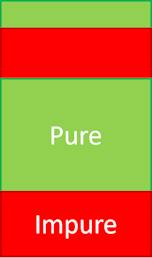
On the other hand, this isn't what the above code suggestion does. The problem with the song recommendation algorithm is that the impure actions cascade. While we start with a single impure out-of-process query, we then use the result of that to loop over, and perform n more queries. This, in fact, happens again, nested in the outer loop, so in terms of network calls, we're looking at an O(n2) algorithm.
We can actually be more precise than that, because the 'outer' queries actually limit their result sets. The first query only considers the top 100 results, so we know that GetTopListenersAsync is going to be called at most 100 times. The result of this call is again limited to the top 20, so that the inner calls to GetTopScrobblesAsync run at most 20 * 100 = 2,000 times. In all, the upper limit is 1 + 100 + 2,000 = 2,101 network calls. (Okay, so really, this is just an O(1) algorithm, although 1 ~ 2,101.)
Not that that isn't going to take a bit of time.
All that said, it's not execution time that concerns me in this context. Assume that the algorithm is already as optimal as possible, and that those 2,101 network calls are necessary. What rather concerns me here is how to organize the code in a way that's as maintainable as possible. As usual, when that's the main concern, I'll remind the reader to consider the example problem as a stand-in for a more complicated problem. Even Oleksii Holub's original code example is only some fifty-odd lines of code, which in itself hardly warrants all the hand-wringing we're currently subjecting it to.
Rather, what I'd like to address is the dynamic back-and-forth between pure function and impure action. Each of these thousands of out-of-process calls are non-deterministic. If you're tasked with maintaining or editing this algorithm, your brain will be taxed by all that unpredictable behaviour. Many subtle bugs lurk there.
The more we can pull the code towards pure functions the better, because referential transparency fits in your head.
So, to be explicit, I don't consider this kind of composition as an expanded Impureim Sandwich.
Standard combinators #
Is it possible to somehow improve, even just a little, on the above suggestion? Can we somehow make it look a little 'more functional'?
We could use some standard combinators, like monadic bind, traversals, and so on.
To be honest, for the specific song-recommendations example, the benefit is marginal at best, but doing it would still demonstrate a particular technique. We'd be able to get rid of the local mutation of recommendationCandidates, but that's about it.
Even so, refactoring to self-contained expressions makes other refactoring easier. As a counter-example, imagine that you'd like to extract the inner foreach loop in the above code example to a helper method.
private async Task CollectOtherUserTopScrobbles(
    List<Song> recommendationCandidates,
    IReadOnlyList<string> otherUserNames)
{
    foreach (var otherUserName in otherUserNames)
    {
        // Impure
        var otherScrobbles = await _songService
            .GetTopScrobblesAsync(otherUserName);

        // Pure
        var songsToRecommend = HandleOtherScrobbles(otherScrobbles);

        recommendationCandidates.AddRange(songsToRecommend);
    }
}
The call site would then look like this:
// Pure
var otherUserNames = HandleOtherListeners(otherListeners);

// Impure
await CollectOtherUserTopScrobbles(recommendationCandidates, otherUserNames);
In this specific example, such a refactoring isn't too difficult, but it's more complicated than it could be. Because of state mutation, we have to pass the object to be modified, in this case recommendationCandidates, along as a method argument. Here, there's only one, but if you have code where you change the state of two objects, you'd have to pass two extra parameters, and so on.
You've most likely worked in a real code base where you have tried to extract a helper method, only to discover that it's so incredibly tangled with the objects that it modifies that you need a long parameter list. What should have been a simplification is in danger of making everything worse.
On the other hand, self-contained expressions, even if, as in this case, they're non-deterministic, don't mutate state. In general, this tends to make it easier to extract subexpressions as helper methods, if only because they are less coupled to the rest of the code. They may required inputs as parameters, but at least you don't have to pass around objects to be modified.
Thus, the reason I find it worthwhile to include articles about this kind of refactoring is that, since it demonstrates how to refactor to a more expression-based style, you may be able to extrapolate to your own context. And who knows, you may encounter a context where more substantial improvements can be made by moving in this direction.
As usual in this article series, you'll see how to apply this technique in three different languages.
- Song recommendations from C# combinators
- Song recommendations from F# combinators
- Song recommendations from Haskell combinators
All that said, it's important to underscore that I don't consider this proper functional architecture. Even the Haskell example is too non-deterministic to my tastes.
Conclusion #
Perhaps the most pragmatic approach to a problem like the song-recommendations example is to allow the impure actions and pure functions to interleave. I don't mean to insist that functional programming is the only way to make code maintainable. You can organize code according to other principles, and some of them may also leave you with a code base that can serve its mission well, now and in the future.
Another factor to take into account is the skill level of the team tasked with maintaining a code base. What are they comfortable with?
Not that I think you should settle for status quo. Progress can only be made if you push the envelop a little, but you can also come up with a code base so alien to your colleagues that they can't work with it at all.
I could easily imagine a team where the solution in the next three articles is the only style they'd be able to maintain.
Testing races with a slow Decorator
Delaying database interactions for test purposes.
In chapter 12 in Code That Fits in Your Head, I cover a typical race condition and how to test for it. The book comes with a pedagogical explanation of the problem, including a diagram in the style of Designing Data-Intensive Applications. In short, the problem occurs when two or more clients are competing for the last remaining seats in a particular time slot.
In my two-day workshop based on the book, I also cover this scenario. The goal is to show how to write automated tests for this kind of non-deterministic behaviour. In the book, and in the workshop, my approach is to rely on the law of large numbers. An automated test attempts to trigger the race condition by trying 'enough' times. A timeout on the test assumes that if the test does not trigger the condition in the allotted time window, then the bug is addressed.
At one of my workshops, one participant told me of a more efficient and elegant way to test for this. I wish I could remember exactly at which workshop it was, and who the gentleman was, but alas, it escapes me.
Reproducing the condition #
How do you deterministically reproduce non-deterministic behaviour? The default answer is almost tautological. You can't, since it's non-deterministic.
The irony, however, is that in the workshop, I deterministically demonstrate the problem. The problem, in short, is that in order to decide whether or not to accept a reservation request, the system first reads data from its database, runs a fairly complex piece of decision logic, and finally writes the reservation to the database - if it decides to accept it, based on what it read. When competing processes vie for the last remaining seats, a race may occur where both (or all) base their decision on the same data, so they all come to the conclusion that they still have enough remaining capacity. Again, refer to the book, and its accompanying code base, for the details.
How do I demonstrate this condition in the workshop? I go into the Controller code and insert a temporary, human-scale delay after reading from the database, but before making the decision:
var reservations = await Repository.ReadReservations(r.At);

await Task.Delay(TimeSpan.FromSeconds(10));

if (!MaitreD.WillAccept(DateTime.Now, reservations, r))
    return NoTables500InternalServerError();

await Repository.Create(restaurant.Id, reservation);
Then I open two windows, from which I, within a couple of seconds of each other, try to make competing reservations. When the bug is present, both reservations are accepted, although, according to business rules, only one should be.
So that's how to deterministically demonstrate the problem. Just insert a long enough delay.
We can't, however, leave such delays in the production code, so I never even considered that this simple technique could be used for automated testing.
Slowing things down with a Decorator #
That's until my workshop participant told me his trick: Why don't you slow down the database interactions for test-purposes only? At first, I thought he had in mind some nasty compiler pragmas or environment hacks, but no. Why don't you use a Decorator to slow things down?
Indeed, why not?
Fortunately, all database interaction already takes place behind an IReservationsRepository interface. Adding a test-only, delaying Decorator is straightforward.
public sealed class SlowReservationsRepository : IReservationsRepository
{
    private readonly TimeSpan halfDelay;

    public SlowReservationsRepository(
        TimeSpan delay,
        IReservationsRepository inner)
    {
        Delay = delay;
        halfDelay = delay / 2;
        Inner = inner;
    }

    public TimeSpan Delay { get; }
    public IReservationsRepository Inner { get; }

    public async Task Create(int restaurantId, Reservation reservation)
    {
        await Task.Delay(halfDelay);
        await Inner.Create(restaurantId, reservation);
        await Task.Delay(halfDelay);
    }

    public async Task Delete(int restaurantId, Guid id)
    {
        await Task.Delay(halfDelay);
        await Inner.Delete(restaurantId, id);
        await Task.Delay(halfDelay);
    }

    public async Task<Reservation?> ReadReservation(
        int restaurantId,
        Guid id)
    {
        await Task.Delay(halfDelay);
        var result = await Inner.ReadReservation(restaurantId, id);
        await Task.Delay(halfDelay);
        return result;
    }

    public async Task<IReadOnlyCollection<Reservation>> ReadReservations(
        int restaurantId,
        DateTime min,
        DateTime max)
    {
        await Task.Delay(halfDelay);
        var result = await Inner.ReadReservations(restaurantId, min, max);
        await Task.Delay(halfDelay);
        return result;
    }

    public async Task Update(int restaurantId, Reservation reservation)
    {
        await Task.Delay(halfDelay);
        await Inner.Update(restaurantId, reservation);
        await Task.Delay(halfDelay);
    }
}
This one uniformly slows down all operations. I arbitrarily decided to split the Delay in half, in order to apply half of it before each action, and the other half after. Honestly, I didn't mull this over too much; I just thought that if I did it that way, I wouldn't have to speculate whether it would make a difference if the delay happened before or after the action in question.
Slowing down tests #
I added a few helper methods to the RestaurantService class that inherits from WebApplicationFactory<Startup>, mainly to enable decoration of the injected Repository. With those changes, I could now rewrite my test like this:
[Fact]
public async Task NoOverbookingRace()
{
    var date = DateTime.Now.Date.AddDays(1).AddHours(18.5);
    using var service = RestaurantService.CreateWith(repo =>
        new SlowReservationsRepository(
            TimeSpan.FromMilliseconds(100), repo));

    var task1 = service.PostReservation(new ReservationDtoBuilder()
        .WithDate(date)
        .WithQuantity(10)
        .Build());
    var task2 = service.PostReservation(new ReservationDtoBuilder()
        .WithDate(date)
        .WithQuantity(10)
        .Build());
    var actual = await Task.WhenAll(task1, task2);

    Assert.Single(
        actual,
        msg => msg.StatusCode == HttpStatusCode.InternalServerError);
    var ok = Assert.Single(actual, msg => msg.IsSuccessStatusCode);
    // Check that the reservation was actually created:
    var resp = await service.GetReservation(ok.Headers.Location);
    resp.EnsureSuccessStatusCode();
    var reservation = await resp.ParseJsonContent<ReservationDto>();
    Assert.Equal(10, reservation.Quantity);
}
The restaurant being tested has a maximum capacity of ten guests, so while it can accommodate either of the two requests, it can't make room for both.
For this example, I arbitrarily chose to configure the Decorator with a 100-millisecond delay. Every interaction with the database caused by that test gets a built-in 100-millisecond delay. 50 ms before each action, and 50 ms after.
The test starts both tasks, task1 and task2, without awaiting them. This allows them to run concurrently. After starting both tasks, the test awaits both of them with Task.WhenAll.
The assertion phase of the test is more involved than you may be used to see. The reason is that it deals with more than one possible failure scenario.
The first two assertions (Assert.Single) deal with the complete absence of transaction control in the application. In that case, both POST requests succeed, which they aren't supposed to. If the system works properly, it should accept one request and reject the other.
The rest of the assertions check that the successful reservation was actually created. That's another failure scenario.
The way I chose to deal with the race condition is standard in .NET. I used a TransactionScope. This is peculiar and, in my opinion, questionable API that enables you to start a transaction anywhere in your code, and then complete when you you're done. In the code base that accompanies Code That Fits in Your Head, it looks like this:
private async Task<ActionResult> TryCreate(Restaurant restaurant, Reservation reservation)
{
    using var scope = new TransactionScope(TransactionScopeAsyncFlowOption.Enabled);

    var reservations = await Repository
        .ReadReservations(restaurant.Id, reservation.At)
        .ConfigureAwait(false);
    var now = Clock.GetCurrentDateTime();
    if (!restaurant.MaitreD.WillAccept(now, reservations, reservation))
        return NoTables500InternalServerError();

    await Repository.Create(restaurant.Id, reservation).ConfigureAwait(false);

    scope.Complete();

    return Reservation201Created(restaurant.Id, reservation);
}
Notice the scope.Complete() statement towards the end.
What happens if someone forgets to call scope.Complete()?
In that case, the thread that wins the race returns 201 Created, but when the scope goes out of scope, it's disposed of. If Complete() wasn't called, the transaction is rolled back, but the HTTP response code remains 201. Thus, the two assertions that inspect the response codes aren't enough to catch this particular kind of defect.
Instead, the test subsequently queries the System Under Test to verify that the resource was, indeed, created.
Wait time #
The original test shown in the book times out after 30 seconds if it can't produce the race condition. Compared to that, the refactored test shown here is fast. Even so, we may fear that it spends too much time doing nothing. How much time might that be?
The TryCreate helper method shown above is the only part of a POST request that interacts with the Repository. As you can see, it calls it twice: Once to read, and once to write, if it decides to do that. With a 100 ms delay, that's 200 ms.
And while the test issues two POST requests, they run in parallel. That's the whole point. It means that they'll still run in approximately 200 ms.
The test then issues a GET request to verify that the resource was created. That triggers another database read, which takes another 100 ms.
That's 300 ms in all. Given that these tests are part of a second-level test suite, and not your default developer test suite, that may be good enough.
Still, that's the POST scenario. I also wrote a test that checks for a race condition when doing PUT requests, and it performs more work.
[Fact]
public async Task NoOverbookingPutRace()
{
    var date = DateTime.Now.Date.AddDays(1).AddHours(18.5);
    using var service = RestaurantService.CreateWith(repo =>
        new SlowReservationsRepository(
            TimeSpan.FromMilliseconds(100), repo));
    var (address1, dto1) = await service.PostReservation(date, 4);
    var (address2, dto2) = await service.PostReservation(date, 4);

    dto1.Quantity += 2;
    dto2.Quantity += 2;
    var task1 = service.PutReservation(address1, dto1);
    var task2 = service.PutReservation(address2, dto2);
    var actual = await Task.WhenAll(task1, task2);

    Assert.Single(
        actual,
        msg => msg.StatusCode == HttpStatusCode.InternalServerError);
    var ok = Assert.Single(actual, msg => msg.IsSuccessStatusCode);
    // Check that the reservations now have consistent values:
    var client = service.CreateClient();
    var resp1 = await client.GetAsync(address1);
    var resp2 = await client.GetAsync(address2);
    resp1.EnsureSuccessStatusCode();
    resp2.EnsureSuccessStatusCode();
    var body1 = await resp1.ParseJsonContent<ReservationDto>();
    var body2 = await resp2.ParseJsonContent<ReservationDto>();
    Assert.Single(new[] { body1.Quantity, body2.Quantity }, 6);
    Assert.Single(new[] { body1.Quantity, body2.Quantity }, 4);
}
This test first has to create two reservations in a nice, sequential manner. Then it attempts to perform two concurrent updates, and finally it tests that all is as it should be: That both reservations still exist, but only one had its Quantity increased to 6.
This test first makes two POST requests, nicely serialized so as to avoid a race condition. That's 400 ms.
Each PUT request triggers three Repository actions, for a total of 300 ms (since they run in parallel).
Finally, the test issues two GET requests for verification, for another 2 times 100 ms. Now that I'm writing this, I realize that I could also have parallelized these two calls, but as you read on, you'll see why that's not necessary.
In all, this test waits for 900 ms. That's almost a second.
Can we improve on that?
Decreasing unnecessary wait time #
In the latter example, the 300 ms wait time for the parallel PUT requests are necessary to trigger the race condition, but the rest of the test's actions don't need slowing down. We can remove the unwarranted wait time by setting up two services: One slow, and one normal.
To be honest, I could have modelled this by just instantiating two service objects, but why do something as pedestrian as that when you can turn RestaurantService into a monomorphic functor?
internal RestaurantService Select(Func<IReservationsRepository, IReservationsRepository> selector)
{
    if (selector is null)
        throw new ArgumentNullException(nameof(selector));

    return new RestaurantService(selector(repository));
}
Granted, this is verging on the frivolous, but when writing code for a blog post, I think I'm allowed a little fun.
In any case, this now enables me to rewrite the test like this:
[Fact]
public async Task NoOverbookingRace()
{
    var date = DateTime.Now.Date.AddDays(1).AddHours(18.5);
    using var service = new RestaurantService();
    using var slowService =
        from repo in service
        select new SlowReservationsRepository(TimeSpan.FromMilliseconds(100), repo);

    var task1 = slowService.PostReservation(new ReservationDtoBuilder()
        .WithDate(date)
        .WithQuantity(10)
        .Build());
    var task2 = slowService.PostReservation(new ReservationDtoBuilder()
        .WithDate(date)
        .WithQuantity(10)
        .Build());
    var actual = await Task.WhenAll(task1, task2);

    Assert.Single(
        actual,
        msg => msg.StatusCode == HttpStatusCode.InternalServerError);
    var ok = Assert.Single(actual, msg => msg.IsSuccessStatusCode);
    // Check that the reservation was actually created:
    var resp = await service.GetReservation(ok.Headers.Location);
    resp.EnsureSuccessStatusCode();
    var reservation = await resp.ParseJsonContent<ReservationDto>();
    Assert.Equal(10, reservation.Quantity);
}
Notice how only the parallel execution of task1 and task2 run on the slow system. The rest runs as fast as it can. It's as if the client was hitting two different servers that just happen to connect to the same database. Now the test only waits for the 200 ms described above. The PUT test, likewise, only idles for 300 ms instead of 900 ms.
Near-deterministic tests #
Does this deterministically reproduce the race condition? In practice, it may move us close enough, but theoretically the race is still on. With the increased wait time, it's now much more unlikely that the race condition does not happen, but it still could.
Imagine that task1 queries the Repository. Just as it's received a response, but before task2 starts its query, execution is paused, perhaps because of garbage collection. Once the program resumes, task1 runs to completion before task2 reads from the database. In that case, task2 ends up making the right decision, rejecting the reservation. Even if no transaction control were in place.
This may not be a particularly realistic scenario, but I suppose it could happen if the computer is stressed in general. Even so, you might decide to make such false-negative scenarios even more unlikely by increasing the delay time. Of course, the downside is that tests take even longer to run.
Another potential problem is that there's no guarantee that task1 and task2 run in parallel. Even if the test doesn't await any of the tasks, both start executing immediately. There's an (unlikely) chance that task1 completes before task2 starts. Again, I don't consider this likely, but I suppose it could happen because of thread starvation, generation 2 garbage collection, the disk running full, etc. The point is that the test shown here is still playing the odds, even if the odds are really good.
Conclusion #
Instead of running a scenario 'enough' times that reproducing a race condition is likely, you can increase the odds to near-certainty by slowing down the race. In this example, the race involves a database, but you might also encounter race conditions internally in multi-threaded code. I'm not insisting that the technique described in this article applies universally, but if you can slow down certain interactions in the right way, you may be able reproduce problems as automated tests.
If you've ever troubleshot a race condition, you've probably tried inserting sleeps into the code in various places to understand the problem. As described above, a single, strategically-placed Task.Delay may be all you need to reproduce a problem. What escaped me for a long time, however, was that I didn't realize that I could cleanly insert such pauses into production code. Until my workshop participant suggested using a Decorator.
A delaying Decorator slows interactions with the database down sufficiently to reproduce the race condition as an automated test.
Song recommendations as a Haskell Impureim Sandwich
A pure function on potentially massive data.
This article is part of a larger article series called Alternative ways to design with functional programming. As the title suggests, these articles discuss various ways to apply functional-programming principles to a particular problem. All the articles engage with the same problem. In short, the task is to calculate song recommendations for a user, based on massive data sets. Earlier articles in this series give you detailed explanation of the problem.
In the previous article, you saw how to refactor the 'base' F# code base to a pure function. In this article, you'll see the same refactoring applied to the 'base' Haskell code base shown in Porting song recommendations to Haskell.
The Git branch discussed in this article is the pure-function branch in the Haskell Git repository.
Collecting all the data #
Like in the previous articles, we may start by adding two more methods to the SongService type class, which will enable us to enumerate all songs and all users. The full type class, with all four methods, then looks like this:
class SongService a where
  getAllSongs :: a -> IO [Song]
  getAllUsers :: a -> IO [User]
  getTopListeners :: a -> Int -> IO [User]
  getTopScrobbles :: a -> String -> IO [Scrobble]
If you compare with the type class definition shown in the article Porting song recommendations to Haskell, you'll see that getAllSongs and getAllUsers are the new methods.
They enable you to collect all top listeners, and all top scrobbles, even though it may take some time. To gather all the top listeners, we may add this collectAllTopListeners action:
collectAllTopListeners srvc = do
  songs <- getAllSongs srvc
  listeners <- newIORef Map.empty
  forM_ songs $ \song -> do
    topListeners <- getTopListeners srvc $ songId song
    modifyIORef listeners (Map.insert (songId song) topListeners)
  readIORef listeners
Likewise, you can amass all the top scrobbles with a similar action:
collectAllTopScrobbles srvc = do
  users <- getAllUsers srvc
  scrobbles <- newIORef Map.empty
  forM_ users $ \user -> do
    topScrobbles <- getTopScrobbles srvc $ userName user
    modifyIORef scrobbles (Map.insert (userName user) topScrobbles)
  readIORef scrobbles
As you may have noticed, they're so similar that, had there been more than two, we might consider extracting the similar parts to a reusable operation.
In both cases, we start with the action that enables us to enumerate all the resources (songs or scrobbles) that we're interested in. For each of these, we then invoke the action to get the 'top' resources for that song or scrobble. There's a massive n+1 problem here, but you could conceivably parallelize all these queries, as they're independent. Still, it's bound to take much time, possibly hours.
You may be wondering why I chose to use IORef values for both actions, instead of more idiomatic combinator-based expressions. Indeed, that is what I would usually do, but in this case, these two actions are heavily IO-bound already, and it makes the Haskell code more similar to the F# code. Not that that is normally a goal, but here I thought it might help you, the reader, to compare the different code bases.
All the data is kept in a Map per action, so two massive maps in all. Once these two actions return, we're done with the read phase of the Recawr Sandwich.
Referentially transparent function with local mutation #
As a first step, we may wish to turn the getRecommendations action into a referentially transparent function. If you look through the commits in the Git repository, you can see that I actually did this through a series of micro-commits, but here I only present a more coarse-grained version of the changes I made.
In this version, I've removed the srvc (SongService) parameter, and instead added the two maps topScrobbles and topListeners.
getRecommendations :: Map String [Scrobble] -> Map Int [User] -> String -> IO [Song]
getRecommendations topScrobbles topListeners un = do
  -- 1. Get user's own top scrobbles
  -- 2. Get other users who listened to the same songs
  -- 3. Get top scrobbles of those users
  -- 4. Aggregate the songs into recommendations

  let scrobbles = Map.findWithDefault [] un topScrobbles
  let scrobblesSnapshot = take 100 $ sortOn (Down . scrobbleCount) scrobbles

  recommendationCandidates <- newIORef []
  forM_ scrobblesSnapshot $ \scrobble -> do
    let otherListeners =
          Map.findWithDefault [] (songId $ scrobbledSong scrobble) topListeners
    let otherListenersSnapshot =
          take 20 $
          sortOn (Down . userScrobbleCount) $
          filter ((10_000 <=) . userScrobbleCount) otherListeners

    forM_ otherListenersSnapshot $ \otherListener -> do
      let otherScrobbles =
            Map.findWithDefault [] (userName otherListener) topScrobbles
      let otherScrobblesSnapshot =
            take 10 $
            sortOn (Down . songRating . scrobbledSong) $
            filter (songHasVerifiedArtist . scrobbledSong) otherScrobbles

      forM_ otherScrobblesSnapshot $ \otherScrobble -> do
        let song = scrobbledSong otherScrobble
        modifyIORef recommendationCandidates (song :)

  recommendations <- readIORef recommendationCandidates
  return $ take 200 $ sortOn (Down . songRating) recommendations
You've probably noticed that this action still looks impure, since it returns IO [Song]. Even so, it's referentially transparent, since it's fully deterministic and without side effects.
The way I refactored the action, this order of changes was what made most sense to me. Getting rid of the SongService parameter was more important to me than getting rid of the IO wrapper.
In any case, this is only an interim state towards a more idiomatic pure Haskell function.
A single expression #
A curious property of expression-based languages is that you can conceivably write functions in 'one line of code'. Granted, it would often be a terribly wide line, not at all readable, a beast to maintain, and often with poor performance, so not something you'd want to alway do.
In this case, however, we can do that, although in order to stay within an 80x24 box, we break the expression over multiple lines.
getRecommendations :: Map String [Scrobble] -> Map Int [User] -> String -> [Song]
getRecommendations topScrobbles topListeners un =
  -- 1. Get user's own top scrobbles
  -- 2. Get other users who listened to the same songs
  -- 3. Get top scrobbles of those users
  -- 4. Aggregate the songs into recommendations

  take 200 $
  sortOn (Down . songRating) $
  fmap scrobbledSong $
  (\otherListener -> take 10 $
      sortOn (Down . songRating . scrobbledSong) $
      filter (songHasVerifiedArtist . scrobbledSong) $
      Map.findWithDefault [] (userName otherListener) topScrobbles) =<<
  (\scrobble -> take 20 $
    sortOn (Down . userScrobbleCount) $
    filter ((10_000 <=) . userScrobbleCount) $
    Map.findWithDefault [] (songId $ scrobbledSong scrobble) topListeners) =<<
  take 100
  (sortOn (Down . scrobbleCount) $ Map.findWithDefault [] un topScrobbles)
This snapshot also got rid of the IORef value, and IO in general. The function is still referentially transparent, but now Haskell can also see that.
Even so, this looks dense and confusing. It doesn't help that Haskell should usually be read right-to-left, and bottom-to-top. Is it possible to improve the readability of this function?
Composition from smaller functions #
To improve readability and maintainability, we may now extract helper functions. The first one easily suggests itself.
getUsersOwnTopScrobbles :: Ord k => Map k [Scrobble] -> k -> [Scrobble]
getUsersOwnTopScrobbles topScrobbles un =
  take 100 $
  sortOn (Down . scrobbleCount) $ Map.findWithDefault [] un topScrobbles
Each of the subexpressions in the above code listing are candidates for the same kind of treatment, like this one:
getOtherUsersWhoListenedToTheSameSongs :: Map Int [User] -> Scrobble -> [User]
getOtherUsersWhoListenedToTheSameSongs topListeners scrobble =
  take 20 $
  sortOn (Down . userScrobbleCount) $
  filter ((10_000 <=) . userScrobbleCount) $
  Map.findWithDefault [] (songId $ scrobbledSong scrobble) topListeners
You can't see it from the code listings themselves, but the module doesn't export these functions. They remain implementation details.
With a few more helper functions, you can now implement the getRecommendations function by composing the helpers.
getRecommendations :: Map String [Scrobble] -> Map Int [User] -> String -> [Song]
getRecommendations topScrobbles topListeners un =
  -- 1. Get user's own top scrobbles
  -- 2. Get other users who listened to the same songs
  -- 3. Get top scrobbles of those users
  -- 4. Aggregate the songs into recommendations

  aggregateSongsIntoRecommendations $
  getTopSongsOfOtherUser topScrobbles =<<
  getOtherUsersWhoListenedToTheSameSongs topListeners =<<
  getUsersOwnTopScrobbles topScrobbles un
Since Haskell by default composes from right to left, when you break such a composition over multiple lines (in order to stay within a 80x24 box), it should be read bottom-up.
You can remedy this situation by importing the & operator from Data.Function:
getRecommendations :: Map String [Scrobble] -> Map Int [User] -> String -> [Song]
getRecommendations topScrobbles topListeners un =
  getUsersOwnTopScrobbles topScrobbles un >>=
  getOtherUsersWhoListenedToTheSameSongs topListeners >>=
  getTopSongsOfOtherUser topScrobbles &
  aggregateSongsIntoRecommendations
Notice that I've named each of the helper functions after the code comments that accompanied the previous incarnations of this function. If we consider code comments apologies for not properly organizing the code, we've now managed to structure it in such a way that those apologies are no longer required.
Conclusion #
If you accept the (perhaps preposterous) assumption that it's possible to fit the required data in persistent data structures, refactoring the recommendation algorithm to a pure function isn't that difficult. That's the pure part of a Recawr Sandwich. While I haven't shown the actual sandwich here, it's quite straightforward. You can find it in the tests in the Haskell Git repository. Also, once you've moved all the data collection to the boundary of the application, you may no longer need the SongService type class.
I find the final incarnation of the code shown here to be quite attractive. While I've kept the helper functions private to the module, it's always an option to export them if you find that warranted. This could improve testability of the overall code base, albeit at the risk of increasing the surface area of the API that you have to maintain and secure.
There are always trade-offs to be considered. Even if you, eventually, find that for this particular example, the input data size is just too big to make this alternative viable, there are, in my experience, many other situations when this kind of architecture is a good solution. Even if the input size is a decent amount of megabytes, the simplification offered by an Impureim Sandwich may trump the larger memory footprint. As always, if you're concerned about performance, measure it.
This article concludes the overview of using an Recawr Sandwich to address the problem. Since it's, admittedly, a bit of a stretch to imagine running a program that uses terabytes (or more) of memory, we now turn to alternative architectures.
Song recommendations as an F# Impureim Sandwich
A pure function on potentially massive data.
This article is part of a larger article series titled Alternative ways to design with functional programming. In the previous article, you saw an example of applying the Impureim Sandwich pattern to the problem at hand: A song recommendation engine that sifts through much historical data.
As already covered in Song recommendations as an Impureim Sandwich, the drawback, if you will, of a Recawr Sandwich is that you need to collect all data from impure sources before you can pass it to a pure function. It may happen that you need so much data that this strategy becomes untenable. This may be the case here, but surprisingly often, what strikes us humans as being vast amounts are peanuts for computers.
So even if you don't find this particular example realistic, I'll forge ahead and show how to apply the Recawr Sandwich pattern to this problem. This is essentially a port to F# of the C# code from the previous article. If you rather want to see some more realistic architectures to deal with the overall problem, you can always go back to the table of contents in the first article of the series.
In this article, I'm working with the fsharp-pure-function branch of the Git repository.
Collecting all the data #
Like in the previous article, we may start by adding two more members to the SongService interface, which will enable us to enumerate all songs and all users. The full interface, with all four methods, then looks like this:
type SongService =
    abstract GetAllSongs : unit -> Task<IEnumerable<Song>>
    abstract GetAllUsers : unit -> Task<IEnumerable<User>>
    abstract GetTopListenersAsync : songId : int -> Task<IReadOnlyCollection<User>>
    abstract GetTopScrobblesAsync : userName : string -> Task<IReadOnlyCollection<Scrobble>>
If you compare with the interface definition shown in the article Porting song recommendations to F#, you'll see that GetAllSongs and GetAllUsers are the new methods.
They enable you to collect all top listeners, and all top scrobbles, even though it may take some time. To gather all the top listeners, we may add this collectAllTopListeners action:
let collectAllTopListeners (songService : SongService) = task {
    let d = Dictionary<int, IReadOnlyCollection<User>> ()
    let! songs = songService.GetAllSongs ()
    do! songs |> TaskSeq.iter (fun s -> task {
        let! topListeners = songService.GetTopListenersAsync s.Id
        d.Add (s.Id, topListeners) } )
    return d :> IReadOnlyDictionary<_, _> }
Likewise, you can amass all the top scrobbles with a similar action:
let collectAllTopScrobbles (songService : SongService) = task {
    let d = Dictionary<string, IReadOnlyCollection<Scrobble>> ()
    let! users = songService.GetAllUsers ()
    do! users |> TaskSeq.iter (fun u -> task {
        let! topScrobbles = songService.GetTopScrobblesAsync u.UserName
        d.Add (u.UserName, topScrobbles) } )
    return d :> IReadOnlyDictionary<_, _> }
As you may have noticed, they're so similar that, had there been more than two, we might consider extracting the similar parts to a reusable operation.
In both cases, we start with the action that enables us to enumerate all the resources (songs or scrobbles) that we're interested in. For each of these, we then invoke the action to get the 'top' resources for that song or scrobble. There's a massive n+1 problem here, but you could conceivably parallelize all these queries, as they're independent. Still, it's bound to take much time, possibly hours.
All the data is kept in a dictionary per action, so two massive dictionaries in all. Once these two actions return, we're done with the read phase of the Recawr Sandwich.
Traversals #
You may have wondered about the above TaskSeq.iter action. That's not part of the standard library. What is it, and where does it come from?
It's a specialized traversal, designed to make asynchronous Commands more streamlined.
let iter f xs = task {
    let! units = traverse f xs
    Seq.iter id units }
If you've ever wondered why the identity function (id) is useful, here's an example. In the first line of code, units is a unit seq value; i.e. a sequence of unit values. To make TaskSeq.iter as easy to use as possible, it should turn that multitude of unit values into a single unit value. There's more than one way to do that, but I found that using Seq.iter was about the most succinct option I could think of. Be that as it may, Seq.iter requires as an argument a function that returns unit, and since we already have unit values, id does the job.
The iter action uses the TaskSeq module's traverse function, which is defined like this:
let traverse f xs =
    let go acc x = task {
        let! x' = x
        let! acc' = acc
        return Seq.append acc' [x'] }
    xs |> Seq.map f |> Seq.fold go (task { return [] })
The type of traverse is ('a -> #Task<'c>) -> 'a seq -> Task<'c seq>; that is, it applies an asynchronous action to each of a sequence of 'a values, and returns an asynchronous workflow that contains a sequence of 'c values.
Dictionary lookups #
In .NET, queries that may fail are idiomatically modelled with methods that take out parameters. This is also true for dictionary lookups. Since that kind of design doesn't compose well, it's useful to add a little helper function that instead may return an empty value. While you'd generally do that by returning an option value, in this case, an empty collection is more appropriate.
let findOrEmpty key (d : IReadOnlyDictionary<_, IReadOnlyCollection<_>>) =
   match d.TryGetValue key with
   | true, v -> v
   | _       -> List.empty
You may have noticed that I also added a similar helper function in the C# example, although there I called it GetOrEmpty.
Pure function with local mutation #
As a first step, we may wish to turn the GetRecommendationsAsync method into a pure function. If you look through the commits in the Git repository, you can see that I actually did this through a series of micro-commits, but here I only present a more coarse-grained version of the changes I made.
Instead of a method on a class, we now have a self-contained function that takes, as arguments, two dictionaries, but no SongService dependency.
let getRecommendations topScrobbles topListeners userName =
    // 1. Get user's own top scrobbles
    // 2. Get other users who listened to the same songs
    // 3. Get top scrobbles of those users
    // 4. Aggregate the songs into recommendations

    let scrobbles = topScrobbles |> Dict.findOrEmpty userName
    let scrobblesSnapshot =
        scrobbles
        |> Seq.sortByDescending (fun s -> s.ScrobbleCount)
        |> Seq.truncate 100
        |> Seq.toList

    let recommendationCandidates = ResizeArray ()
    for scrobble in scrobblesSnapshot do
        let otherListeners =
            topListeners |> Dict.findOrEmpty scrobble.Song.Id
        let otherListenersSnapshot =
            otherListeners
            |> Seq.filter (fun u -> u.TotalScrobbleCount >= 10_000)
            |> Seq.sortByDescending (fun u -> u.TotalScrobbleCount)
            |> Seq.truncate 20
            |> Seq.toList

        for otherListener in otherListenersSnapshot do
            let otherScrobbles =
                topScrobbles |> Dict.findOrEmpty otherListener.UserName
            let otherScrobblesSnapshot =
                otherScrobbles
                |> Seq.filter (fun s -> s.Song.IsVerifiedArtist)
                |> Seq.sortByDescending (fun s -> s.Song.Rating)
                |> Seq.truncate 10
                |> Seq.toList

            otherScrobblesSnapshot
            |> List.map (fun s -> s.Song)
            |> recommendationCandidates.AddRange

    let recommendations =
        recommendationCandidates
        |> Seq.sortByDescending (fun s -> s.Rating)
        |> Seq.truncate 200
        |> Seq.toList
        :> IReadOnlyCollection<_>

    recommendations
Since this is now a pure function, there's no need to run as an asynchronous workflow. The function no longer returns a Task, and I've also dispensed with the Async suffix.
The implementation still has imperative remnants. It initializes an empty ResizeArray (AKA List<T>), and loops through nested loops to repeatedly call AddRange.
Even though the function contains local state mutation, none of it escapes the function's scope. The function is referentially transparent because it always returns the same result when given the same input, and it has no side effects.
You might still wish that it was 'more functional', which is certainly possible.
A single expression #
A curious property of expression-based languages is that you can conceivably write functions in 'one line of code'. Granted, it would often be a terribly wide line, not at all readable, a beast to maintain, and often with poor performance, so not something you'd want to alway do.
In this case, however, we can do that, although in order to stay within an 80x24 box, we break the expression over multiple lines.
let getRecommendations topScrobbles topListeners userName =
    // 1. Get user's own top scrobbles
    // 2. Get other users who listened to the same songs
    // 3. Get top scrobbles of those users
    // 4. Aggregate the songs into recommendations

    topScrobbles
    |> Dict.findOrEmpty userName
    |> Seq.sortByDescending (fun s -> s.ScrobbleCount)
    |> Seq.truncate 100
    |> Seq.collect (fun scrobble ->
        topListeners
        |> Dict.findOrEmpty scrobble.Song.Id
        |> Seq.filter (fun u -> u.TotalScrobbleCount >= 10_000)
        |> Seq.sortByDescending (fun u -> u.TotalScrobbleCount)
        |> Seq.truncate 20
        |> Seq.collect (fun otherListener ->
            topScrobbles
            |> Dict.findOrEmpty otherListener.UserName
            |> Seq.filter (fun s -> s.Song.IsVerifiedArtist)
            |> Seq.sortByDescending (fun s -> s.Song.Rating)
            |> Seq.truncate 10
            |> Seq.map (fun s -> s.Song)))
    |> Seq.sortByDescending (fun s -> s.Rating)
    |> Seq.truncate 200
    |> Seq.toList
    :> IReadOnlyCollection<_>
To be honest, the four lines of comments push the function definition over the edge of 24 lines of code, but without them, this variation actually does fit an 80x24 box. Even so, I'm not arguing that this is the best possible way to organize and lay out this function.
You may rightly complain that it's too dense. Perhaps you're also concerned about the arrow code tendency.
I'm not disagreeing, but at least this represents a milestone where the function is not only referentially transparent, but also implemented without local mutation. Not that that really should be the most important criterion, but once you have an entirely expression-based implementation, it's usually easier to break it up into smaller building blocks.
Composition from smaller functions #
To improve readability and maintainability, we may now extract helper functions. The first one easily suggests itself.
let private getUsersOwnTopScrobbles topScrobbles userName =
    topScrobbles
    |> Dict.findOrEmpty userName
    |> Seq.sortByDescending (fun s -> s.ScrobbleCount)
    |> Seq.truncate 100
Each of the subexpressions in the above code listing are candidates for the same kind of treatment, like this one:
let private getOtherUsersWhoListenedToTheSameSongs topListeners scrobble =
    topListeners
    |> Dict.findOrEmpty scrobble.Song.Id
    |> Seq.filter (fun u -> u.TotalScrobbleCount >= 10_000)
    |> Seq.sortByDescending (fun u -> u.TotalScrobbleCount)
    |> Seq.truncate 20
Notice that these helper methods are marked private so that they remain implementation details within the module that exports the getRecommendations function.
With a few more helper functions, you can now implement the getRecommendations function by composing the helpers.
let getRecommendations topScrobbles topListeners =
    getUsersOwnTopScrobbles topScrobbles
    >> Seq.collect (
        getOtherUsersWhoListenedToTheSameSongs topListeners
        >> Seq.collect (getTopSongsOfOtherUser topScrobbles))
    >> aggregateSongsIntoRecommendations
Notice that I've named each of the helper functions after the code comments that accompanied the previous incarnations of this function. If we consider code comments apologies for not properly organizing the code, we've now managed to structure it in such a way that those apologies are no longer required.
Conclusion #
If you accept the (perhaps preposterous) assumption that it's possible to fit the required data in persistent data structures, refactoring the recommendation algorithm to a pure function isn't that difficult. That's the pure part of a Recawr Sandwich. While I haven't shown the actual sandwich here, it's identical to the example shown in Song recommendations as a C# Impureim Sandwich.
I find the final incarnation of the code shown here to be quite attractive. While I've kept the helper functions private, it's always an option to promote them to public functions if you find that warranted. This could improve testability of the overall code base, albeit at the risk of increasing the surface area of the API that you have to maintain and secure.
There are always trade-offs to be considered. Even if you, eventually, find that for this particular example, the input data size is just too big to make this alternative viable, there are, in my experience, many other situations when this kind of architecture is a good solution. Even if the input size is a decent amount of megabytes, the simplification offered by an Impureim Sandwich may trump the larger memory footprint. As always, if you're concerned about performance, measure it.
Before we turn to alternative architectures, we'll survey how this variation looks in Haskell. As is generally the case in this article series, if you don't care about Haskell, you can always go back to the table of contents in the first article in the series and instead navigate to the next article that interests you.
Song recommendations proof-of-concept memory measurements
An attempt at measurement, and some results.
This is an article in a larger series about functional programming design alternatives, and a direct continuation of the previous article. The question lingering after the Impureim Sandwich proof of concept is: What are the memory requirements of front-loading all users, songs, and scrobbles?
One can guess, as I've already done, but it's safer to measure. In this article, you'll find a description of the experiment, as well as some results.
Test program #
Since I don't measure application memory profiles that often, I searched the web to learn how, and found this answer by Jon Skeet. That's a reputable source, so I'm assuming that the described approach is appropriate.
I added a new command-line executable to the source code and made this the entry point:
const int size = 100_000;

static async Task Main()
{
    var before = GC.GetTotalMemory(true);

    var (listeners, scrobbles) = await Populate();

    var after = GC.GetTotalMemory(true);

    var diff = after - before;

    Console.WriteLine("Total memory: {0:N0}B.", diff);

    GC.KeepAlive(listeners);
    GC.KeepAlive(scrobbles);
}
listeners and scrobbles are two dictionaries of data, as described in the previous article. Together, they contain the data that we measure. Both are populated by this method:
private static async Task<(
    IReadOnlyDictionary<int, IReadOnlyCollection<User>>,
    IReadOnlyDictionary<string, IReadOnlyCollection<Scrobble>>)> Populate()
{
    var service = PopulateService();
    var listeners = await service.CollectAllTopListeners();
    var scrobbles = await service.CollectAllTopScrobbles();
    return (listeners, scrobbles);
}
The service variable is a FakeSongService object populated with randomly generated data. The CollectAllTopListeners and CollectAllTopScrobbles methods are the same as described in the previous article. When the method returns the two dictionaries, the service object goes out of scope and can be garbage-collected. When the program measures the memory load, it measures the size of the two dictionaries, but not service.
I've reused the FsCheck generators for random data generation:
private static SongService PopulateService()
{
    var users = RecommendationsProviderTests.Gen.UserName.Sample(size);
    var songs = RecommendationsProviderTests.Gen.Song.Sample(size);
    var scrobbleGen =
        from user in Gen.Elements(users)
        from song in Gen.Elements(songs)
        from scrobbleCount in Gen.Choose(1, 10)
        select (user, song, scrobbleCount);

    var service = new FakeSongService();
    foreach (var (user, song, scrobbleCount) in scrobbleGen.Sample(size))
        service.Scrobble(user, song, scrobbleCount);

    return service;
}
A Gen<T> object comes with a Sample method you can use to request a specified number of randomly generated values.
In order to keep the code simple, I used the size value for both the number of songs, number of users, and number of scrobbles. This probably creates too few scrobbles; a topic that requires further discussion later.
Measurements #
I ran the above program with various size values; 100,000 up to 1,000,000 in 100,000 increments, and from there up to 1,000,000 (one million) in 500,000 increments. At the higher values, it took a good ten minutes to run the program.
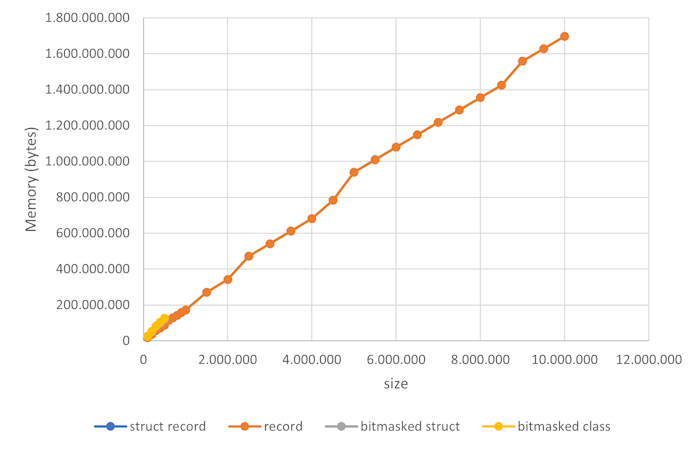
As the chart indicates, I ran the program with various data representations (more on that below). While there are four distinct data series, they overlap pairwise so perfectly that the graph doesn't show the difference. The record and struct record data series are so identical that you can't visibly see the difference. The same is true for the bitmasked class and the bitmasked struct data series, which only go to size 500,000.
There are small, but noticeable jumps from 4,500,000 to 5,000,000 and again from 8,500,000 to 9,000,000, but the overall impression is that the relationship is linear. It seems safe to conclude that the solution scales linearly with the data size.
The number of bytes per size is almost constant and averages to 178 bytes. How does that compare to my previous memory size estimates? There, I estimated a song and a scrobble to require 8 bytes each, and a user less than 32 bytes. The way the above simulation runs, it generates one song, one user, and one scrobble per size unit. Therefore, I'd expect the average memory cost per experiment size to be around 8 + 8 + 32 = 48, plus some overhead from the dictionaries.
Given that the number I measure is 178, that's 130 bytes of overhead. Honestly, that's more than I expected. I expect a dictionary to maintain an array of keys, perhaps hashed with a bucket per hash value. Perhaps, had I picked another data structure than a plain old Dictionary, it's possible that the overhead would be different. Or perhaps I just don't understand .NET's memory model, when push comes to shove.
I then tried to split the single size parameter into three that would control the number of users, songs, and scrobbles independently. Setting both the number of users and songs to ten million, I then ran a series of simulations with increasing scrobble counts.
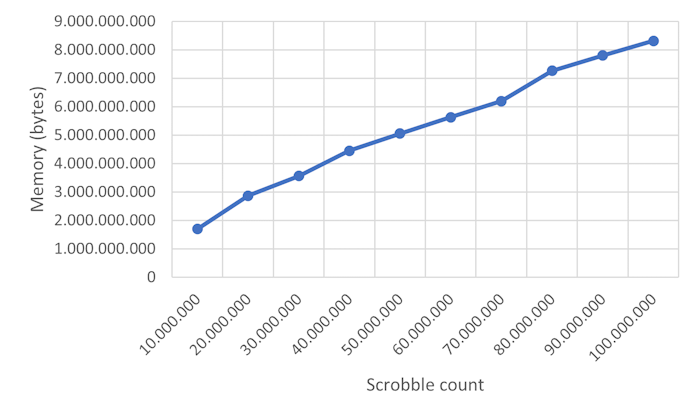
The relationship still looks linear, and at a hundred million scrobbles (and ten million users and ten million songs), the simulation uses 8.3 GB of memory.
I admit that I'm still a bit puzzled by the measurements, compared to my previous estimates. I would have expected those sizes to require about 1,2 GB, plus overhead, so the actual measurements are off by a factor of 7. Not quite an order of magnitude, but close.
Realism #
How useful are these measurements? How realistic are the experiments' parameters? Most streaming audio services report having catalogues with around 100 million songs, which is ten times more than what I've measured here. Such services may also have significantly more users than ten million, but what is going to make or break this architecture option (keeping all data in memory) is how many scrobbles users have, and how many times they listen to each song.
Even if we naively still believe that a scrobble only takes up 8 bytes, it doesn't follow automatically that 100 scrobbles take up 800 bytes. It depends on how many repeats there are. Recall how we may model a scrobble:
public sealed record Scrobble(Song Song, int ScrobbleCount);
If a user listens to the same song ten times, we don't have to create ten Scrobble objects; we can create one and set the ScrobbleCount to 10.
The memory requirement to store users' scrobbles depend on the average listening pattern. Even with millions of users, we may be able to store scrobbles in memory if users listen to relatively few songs. On the other hand, if they only listen to each song once, it's probably not going to fit in memory.
Still, we're dangerously close to the edge of what we can fit in memory. Shouldn't I just declare bankruptcy on that idea and move on?
The purpose of this overall article series is to demonstrate alternatives to the Impureim Sandwich pattern, so I'm ultimately going to do exactly that: Move on.
But not yet.
Sharding #
Some applications are truly global in nature, and when that's the case, keeping everything in memory may not be 'web scale'.
Still, I've seen more than one international company treat geographic areas as separate entities. This may be for legal reasons, or other business concerns that are unrelated to technology constraints.
As a programmer, you may think that a song recommendations service ought to be truly global. After all, more data produces more accurate results, right?
Your business owners may not think so. They may be concerned that regional music tastes may 'bleed over' market boundaries, and that this could ultimately scare customers away.
Even if you can technically prove that this isn't a relevant concern, because you can write an algorithm that takes this into account, you may get a direct order that, say, Southeast Asian scrobbles may not be used in North America, or vice verse.
It's worth investigating whether such business or legal constraints are already in place, because if they are, this may mean that you can shard the data, and that each shard still fits in memory.
You may still think that I'm trying to salvage a bad idea, but that's not my agenda. I discuss these topics because in my experience, many programmers don't consider them. Understanding the wider context of a problem may suggest solutions that you might otherwise dismiss.
But what if the business constraints change in the future? Shouldn't we be ready for that?
Yes and no. You should consider how such changes would impact the architecture. Then you discuss the advantages and disadvantages with other stakeholders.
Keep in mind that the reason to consider an Impureim Sandwich is because it's simple and easy to implement and maintain. Other alternatives may be more 'scalable', but also riskier to implement. You should involve other stakeholders in such decisions.
Song representations #
The first of the above charts draws graphs for four data series:
- struct record
- record
- bitmasked struct
- bitmasked class
These measure four different ways to model data; here more specifically a song.
My initial model of a song was a record:
public sealed record Song(int Id, bool IsVerifiedArtist, byte Rating);
Then I thought that perhaps, since the type only contains value types, it might be better to turn the above record into a record struct:
public record struct Song(int Id, bool IsVerifiedArtist, byte Rating);
It turns out that it makes no visible difference. In the chart, the two data series are so close to each other that you can't distinguish them.
Then I thought that instead of an int, a bool, and a byte, I could use a single bitmask to model all three values.
After all, I was only guessing when it came to data types anyway. It's likely that Rating is only a five-point or ten-point scale, but I still used a byte to model it. This suggests that I'm not using 96% of the data type's range. Perhaps I could use one of those redundant bits for IsVerifiedArtist, instead of an entire bool.
Taking this further, modelling the Id as an int suggests that you may have 4,294,967,295 unique songs. That's 4.3 billion songs - at least an order of magnitude more than those 100 million songs that we hear about. In reality though, most systems that use int for IDs only do so because int is CLS-compliant, and uint is not. In other words, most systems that use int for IDs most likely only use the positive half, which means there are 16 bytes to use for other purposes. Enter the bitmasked song:
public readonly struct Song
{
    private const uint idMask =
        0b0000_0111_1111_1111_1111_1111_1111_1111;
    private const uint isVerifiedArtistMask =
        0b1000_0000_0000_0000_0000_0000_0000_0000;
    private const uint ratingMask =
        0b0111_1000_0000_0000_0000_0000_0000_0000;
    private readonly uint bits;

    public Song(int id, bool isVerifiedArtist, byte rating)
    {
        var idBits = (uint)id & idMask;
        var isVerifiedArtistBits = isVerifiedArtist ? isVerifiedArtistMask : 0u;
        var ratingBits = ((uint)rating << 27) & ratingMask;
        bits = idBits | isVerifiedArtistBits | ratingBits;
    }

    public int Id => (int)(bits & idMask);

    public bool IsVerifiedArtist =>
        (bits & isVerifiedArtistMask) == isVerifiedArtistMask;

    public byte Rating => (byte)((bits & ratingMask) >> 27);
}
In this representation, I've set aside the lower 27 bits for the ID, enabling IDs to range between 0 and 134,217,727. The top bit is used for IsVerifiedArtist, and the remaining four bits for Rating.
This data structure only holds a single uint, and since I made it a struct, I thought it'd have minimal overhead.
As you can see in the above chart, that's not the case. When I run the experiment, this representation requires more memory.
Just to make sure I wasn't missing anything obvious, I tried making the bitmasked Song a class instead. No visible difference.
If you're wondering why the bitmasked data series only go to 500,000, it's because this change made the experiments glacial. It took somewhere between 12 and 24 hours to run the experiment with a size of 500,000.
For what it's worth, I don't think the slowdown is directly related to the data representation, but rather to the change I had to make to the FsCheck-based data generator:
let songParams = gen {
    let maxId = 0b0111_1111_1111_1111_1111_1111_1111
    let! songId = Gen.choose (1, maxId)
    let! isVerified = ArbMap.generate ArbMap.defaults
    let! rating = Gen.choose (0, 10) |> Gen.map byte
    return songId, isVerified, rating }

[<CompiledName "Song">]
let song = gen {
    let! (id, isVerifiedArtist, rating) = songParams
    return Song (id, isVerifiedArtist, rating) }
I can't explain why the bitmasked representation requires more memory, but I'm increasingly having a nagging feeling that I've made a mistake somewhere. If you can spot a mistake, please let me know by leaving a comment.
Other data representations #
I also considered whether it'd make sense to represent the entire data set as a huge matrix. One could, for example, let rows represent users, and columns songs, and let each element represent the number of times a user has listened to a particular song:
| User | Song 1 | Song 2 | Song 3 | ... |
| 123 | 0 | 0 | 4 | ... |
| 456 | 2 | 0 | 4 | ... |
| ... | ||||
Let's say that you may expect some users to listen to a song more than 255 times, but probably not more than 65,535 times. Thus, you could store each play count as a ushort. Still, you would need users x songs values, so if you have 100 million songs and 10 million users, that implies 2 PB of memory. That doesn't sound useful.
On the other hand, most of those elements are going to be 0, so perhaps one could use an adjacency list instead. That is, however, essentially what an IReadOnlyDictionary<string, IReadOnlyCollection<Scrobble>> is, so we're now back where we started.
Conclusion #
This article reports on some measurements I've made of memory requirements, assuming that we keep all scrobble data in memory. While I suspect that I've made a mistake, it still seems reasonable to conclude that the song recommendations scenario is on the edge of what's possible with the Impureim Sandwich pattern.
That's okay. I'm interested in understanding the limitations of solutions.
I do think, however, that it's worth taking note of just how massive amounts of data are required before the Impureim Sandwich pattern becomes untenable.
When I describe the pattern, the most common reaction is that it doesn't scale. And, as this article has explored, it's true that it doesn't scale. But it scales much, much better than you think. You may have billions of entities in your system, and they may still fit in a few gigabytes. Don't dismiss the Impureim Sandwich before you've made a real effort to understand the memory implications of it. Your intuition is likely to work against you.
I'll round off this part of the article series by showing how the Impureim Sandwich looks in other, more functional languages.

Comments
Unfortunately I haven't read your book, so perhaps this question is already answered there: how would a transaction prevent a race condition? I would have expected to solve it using optimistic concurrency control.
My other point is regarding artificial delays. How is that deterministic? If you're injecting decorators to take advantage of seams in the code, and you know the number of operations, then you don't need delays at all. To highlight the race condition you need to ensure two requests have read the same data concurrently. After that you can allow the writes, expecting one to succeed and the other to fail. You could use a synchronization primitive, such as CountdownEvent. Initialize it with a count of 2 to represent your concurrent requests. Repository.ReadReservations() would call Signal() to decrement it after fetching from the database. Repository.Create() would call Wait() to ensure both reads had been made before writing to the database.
Nick, thank you for writing. Regarding the transaction, as the above
TryCreatesnippet shows, it wraps both the read and the write operation, and since the default isolation level isSerializable,As to the second point, I don't think I've claimed that inducing an artificial delay as a Decorator is deterministic. To the contrary, I explicitly discussed how this is only near-deterministic.
That said, you're correct that there's an even better way, and I have another article queued up that takes an approach similar to the one that you describe.